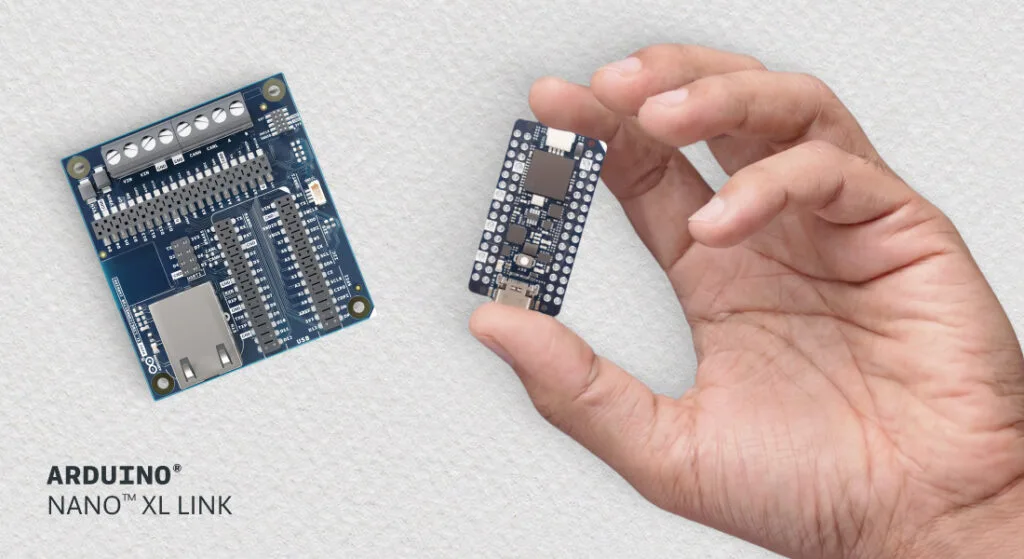
Arduino has unveiled the Nano XL Link at electronica 2026 (Munich, November 10–13, 2026), marking a significant expansion of its widely-adopted Nano microcontroller line. The new board maintains the recognizable form factor and ecosystem compatibility that have made the original Nano popular across countless projects, while introducing capabilities tailored toward industrial and building automation applications.
Industrial connectivity in a compact package
The Nano XL Link retains the compact dimensions and familiar pinout of its predecessor, but integrates three on-board fieldbus transceivers: CAN FD, RS485, and 10/100 Ethernet. This integration eliminates the need for separate external interface hardware, allowing direct connection to industrial networks, motor drives, building automation systems, smart sensors, and control panels without expanding the board's footprint.
At its core sits a Microchip PIC32CK2051SG01144 microcontroller—a 32-bit ARM Cortex-M33 processor operating at 120 MHz with 2 MB of Flash memory and 512 kB of RAM. This architecture delivers the deterministic real-time performance and reliability demanded by factory automation and sophisticated building management environments. An extended double-row header expands the standard Nano pinout, providing additional I/O options for complex automation scenarios.
The board aims to bridge the gap between Arduino's rapid prototyping culture and the requirements of professional industrial deployment. Potential applications include real-time machine controllers, fieldbus gateways, intelligent lighting and HVAC zone management, and automated energy management nodes.
From prototype to production cabinet
Accompanying the Nano XL Link is the Nano XL Link Connector Carrier, a DIN-rail-mountable housing designed for standard 4U industrial enclosures. The carrier features screw terminal connectors for CAN FD and RS485 interfaces, plus a standard RJ45 port for Ethernet connectivity. Users can insert the Nano XL Link, connect field devices via wiring terminals, and begin transitioning prototypes toward production deployment.
Beyond its practical mounting function, the Connector Carrier serves as a reference design for teams developing custom carrier boards for specialized applications. The layout and interface decisions reflect common industrial integration challenges, offering a foundation that can be modified for specific use cases without requiring a complete redesign.
Together, these two products create an integrated platform spanning from initial Arduino code development through installation in a production control cabinet, potentially reducing the need for hardware redesigns or platform transitions during the deployment phase.
The start of a broader initiative
Arduino positions the Nano XL Link and Connector Carrier as the opening chapter of a new ecosystem. The Nano XL family is intended to expand over time, bringing Arduino's philosophy of openness, accessibility, and developer-friendly experience to sectors that have traditionally relied on expensive, closed-source hardware and specialized technical knowledge.
Visitors to electronica 2026 can learn more at the Qualcomm booth (Hall C5 #439). Those interested in early access can register to receive notification when the Nano XL Link and Nano XL Link Connector Carrier become available for purchase.
Source: Arduino Blog