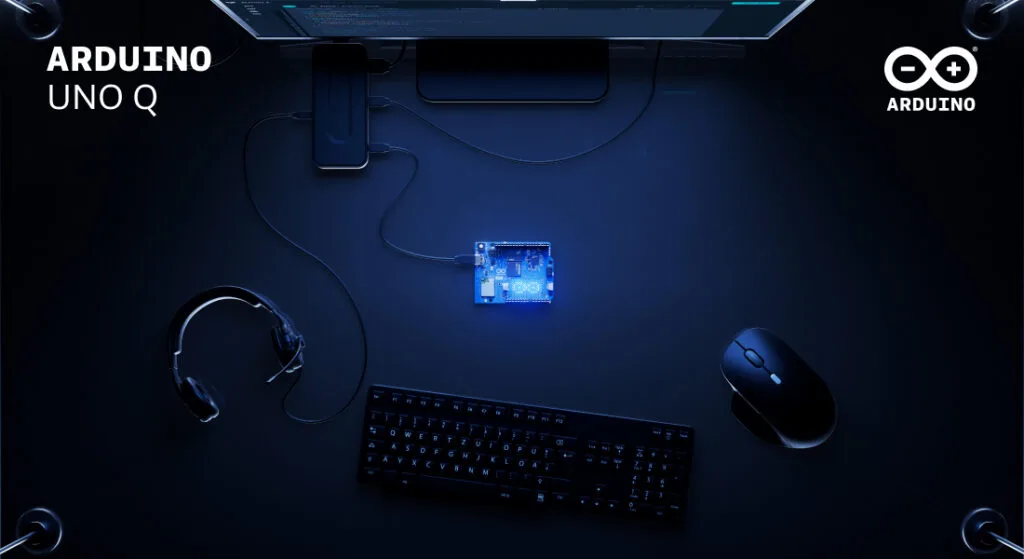
Built on a dual-processor design, the Arduino UNO Q merges high-performance computing with immediate hardware responsiveness in one device. Its Linux-based main processor unit accepts standard open-source applications—the kind engineers already know from servers and single-board computers. Simultaneously, an STM32H5 microcontroller executes Arduino Core on Zephyr RTOS, delivering reliable, time-sensitive management of sensors, actuators, and input-output operations. This pairing transforms the board into something greater than either component alone.
What follows are six concrete use cases: established software platforms deployable on UNO Q right now, the capabilities each unlocks, and why having both a microcontroller and a general-purpose processor on the same hardware changes what becomes feasible.
#1 Agentic AI development
The UNO Q positions an AI coding agent directly within the hardware it operates on. Such an agent can accept objectives, evaluate circumstances, invoke tools, connect with external systems, and—leveraging the board's hardware connections—translate those decisions into tangible outcomes. While reasoning depends on a frontier model accessed via API, tool execution happens locally on the device. This distinction matters: unlike an agent running on a workstation or cloud server, the system making decisions sits physically wired to sensors and actuators.
Getting started involves deploying an AI coding agent like OpenCode directly onto the board. When furnished with suitable context—such as familiarity with the Arduino App Lab CLI and the board's particular specifications—it can configure Linux services, respond to questions about Debian on UNO Q, and construct end-to-end physically connected Arduino applications: write the application, compose the sketch, push it to hardware, observe results, refine. While any agent can draft a sketch, only one residing on the board can deploy it and witness the outcome.
This establishes a substantive connection between generative AI and embedded systems development. Only the reasoning escapes the board; sensors, actuators, and information remain onsite.
#2 Home Assistant
Home Assistant transforms UNO Q into a hub for localized smart home or building control, unifying lights, temperature systems, energy monitors, and other compatible devices through a unified interface and automation framework. Operating exclusively on the Linux side, it manages scheduling, historical records, user interfaces, and system connections—all without requiring cloud-based subscriptions.
The advantage becomes apparent when custom hardware joins the setup. A Qwiic temperature and air-quality sensor plugged into the board's Qwiic connector can stream measurements into Home Assistant, while an Arduino sketch on the STM32H5 microcontroller manages a ventilation fan relay according to those readings. Home Assistant oversees decision-making and presentation on Linux; the microcontroller operates the physical mechanisms. They coordinate via the integrated RPC bridge, requiring no separate Arduino hardware.
#3 n8n automation
n8n provides a graphical workflow automation system designed to link services, APIs, databases, and hardware—functioning as a self-hosted counterpart to Zapier or Make, with complete data control because operations stay on premises.
Deploying n8n on UNO Q extends these workflows to the network edge. A single workflow might gather sensor information from the microcontroller side, refine and archive it in an on-site database, refresh a display, transmit an alert to a remote service, and activate a physical output—sequentially, all within one device.
This pairing positions UNO Q as an effective foundation for experimental development, industrial process control, building management systems, and localized edge orchestration where cloud delays or reliance would create obstacles.
#4 Pi-hole network shield
Pi-hole operates as a DNS-based filtering mechanism engineered to suppress advertisements, tracking software, and unwanted communications across every device on the local network using it as a DNS resolver. On a conventional single-board computer, that capability stands alone.
UNO Q diverges from this pattern: the Linux side executes Pi-hole and its administrative interface, whereas the microcontroller can operate a dedicated status indicator, display blocked-request statistics live, sound an alarm if the DNS service stops functioning, or supply a physical switch to momentarily suspend filtering—all without requiring browser access.
This exemplifies a wider principle: UNO Q converts stationary software into systems featuring tangible feedback and operator control.
#5 Frigate camera computer vision
Frigate functions as a network video recorder centered on instantaneous object recognition. It scrutinizes camera feeds in real time to spot people, vehicles, animals, or other specified objects—and executing it on UNO Q maintains that analysis at the edge, where processing should occur.
UNO Q serves as a sensible platform for Frigate for multiple reasons. Video sources can be linked directly via USB or retrieved remotely through RTSP (Real Time Streaming Protocol). When Frigate identifies a relevant occurrence, the microcontroller side reacts instantaneously—activating a lamp, sounding an alarm, controlling a relay, or illuminating a Modulino-based indicator—without requiring extra components.
Sensitive recordings remain on-site. Reaction speeds accelerate. Physical responses bypass cloud communication.
#6 Local NAS with SMB
UNO Q can function as a compact network-attached storage device via SMB, rendering shared directories available to other machines and systems on the local network—practical for video archives, machine-learning training data, measurement logs, or collaborative documents.
Combined with an adapter providing wired network connectivity and an external USB drive, this becomes a straightforward, instantaneous NAS suitable for distributing office materials with colleagues or household members.
A platform, not just a single application
Each application delivers independent utility. The compelling possibilities emerge when multiple applications operate simultaneously.
Consider this realistic scenario: Frigate spots a person in a monitored zone and broadcasts the detection through MQTT. Home Assistant receives that signal and illuminates a light. n8n amplifies the reaction by contacting an external API, recording the event in a database, and dispatching a message. Meanwhile, the original video remains accessible via the local Samba share. The microcontroller activates an indicator throughout. Everything executes on a single board.
UNO Q furnishes a unified substrate where Linux applications, localized AI processing, network services, and real-time embedded control function as one integrated ecosystem—rather than dispersed across separate devices, each with independent power, housing, and failure points.
UNO Q is obtainable through the Arduino Store or from DigiKey, Farnell, Mouser, Newark, RS Components, Robu.in, and numerous other licensed distributors and resellers.
Source: Arduino Blog