Deeptech scaleups participating in the EIC Scaling Club have mobilised over €4 billion in funding since joining the initiative, which operates as part of the EIC Business Acceleration Services. A fresh analysis shows their capital attraction has accelerated 2.3 times faster than that of peer companies, when measured against the investment each received before programme entry.
Members attracted funding equal to 128 per cent of their pre-joining investment totals, substantially outpacing a control group of 240 eligible but unselected applicants, which secured only 56 per cent of their prior investment levels.
The EIC Scaling Club began accepting its inaugural cohort in April 2024, with a second wave joining in October 2024. The current assessment examines performance data from 120 companies spread across 26 European nations, with information gathered through 29 September 2026.
Portfolio companies outperform comparable peers
Among the 119 active portfolio members, 56 per cent secured fresh funding after joining, compared with just 38 per cent of the control group. Those Club members who raised capital did so at an average of €60.6 million each, versus €39.7 million for the comparison cohort.
Space and computing technologies lead investment flows
Investment patterns reveal a concentration in sectors deemed vital for European technological independence and resilience. New Space and Next-Gen Computing captured the highest funding volumes, attracting €1.34 billion and €1.32 billion respectively. Renewable Energies followed with €589 million, with these three sectors representing roughly 80 per cent of all capital raised.
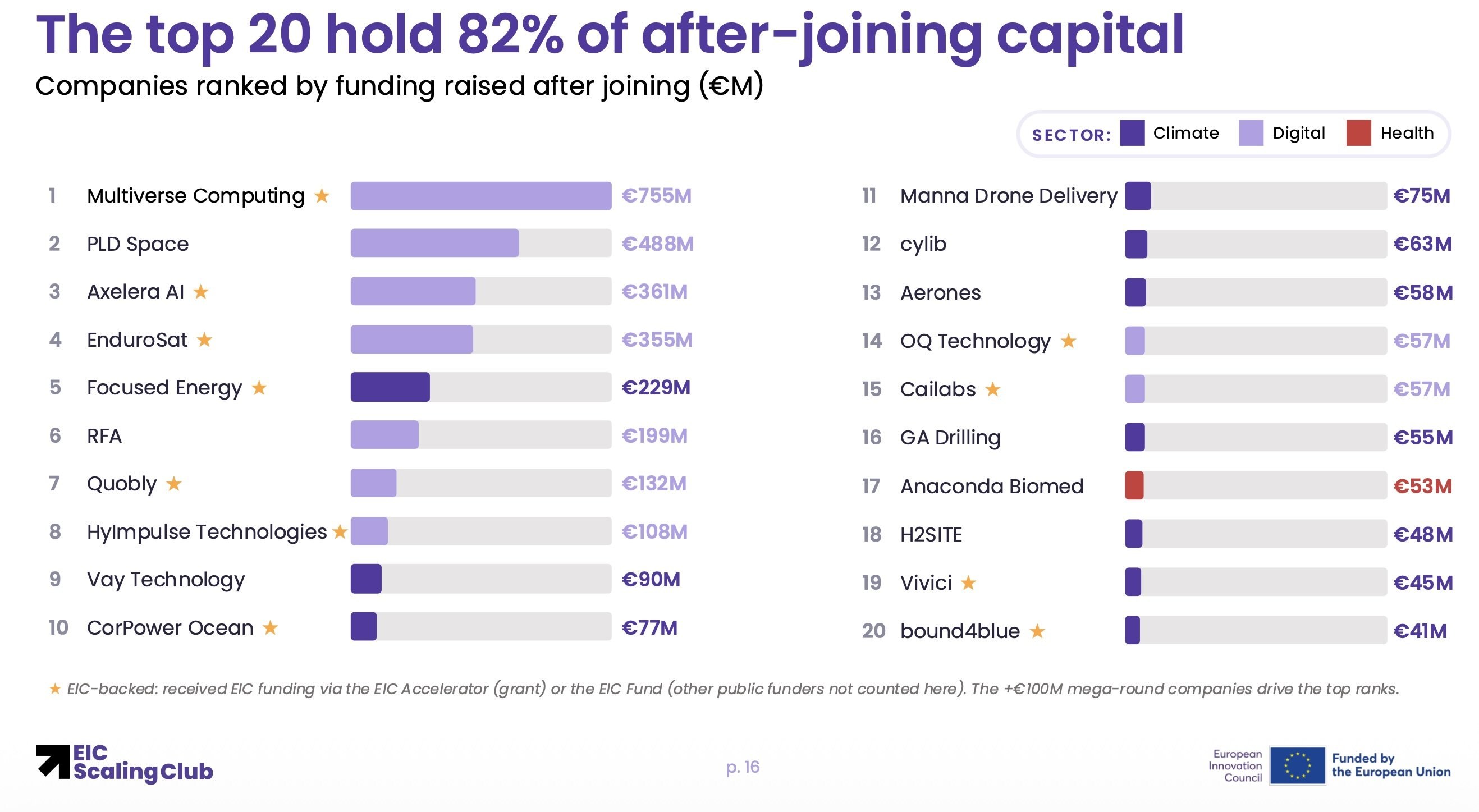
Nine funding rounds each exceeded €100 million, collectively representing more than half of total capital deployed. Eight of these mega-rounds involved either the EIC or another public co-investor. Notable examples include a €500 million round for Spanish quantum and AI firm Multiverse Computing, €288 million raised by Spanish space company PLD Space, and €234 million secured by Netherlands-based AI computing specialist Axelera AI.
Geographic concentration was pronounced, with Spain leading at €1.48 billion, trailed by Germany with €750 million, the Netherlands with €508 million, Bulgaria with €390 million and France with €369 million.
Public capital underpins deeptech expansion
Roughly 80 per cent of capital came through investment rounds involving the EIC or other public backers, underscoring their role in supporting European deeptech growth. Yet international investors remain significant contributors to larger deals, accounting for 18 per cent of investor participations overall and rising to 27 per cent in rounds surpassing €100 million.
Innovation only truly makes a difference when it reaches people in their everyday lives, when workers on the ground develop it and becomes accessible to everyone. That is why helping deeptech startups grow and bring their innovations to market is so important, both for society and for Europe's competitiveness.
Michiel Scheffer, President of the European Innovation Council Board
Ecosystem connections extend beyond capital
Capital access represents only one dimension of deeptech scaling. According to Ezequiel Sánchez, Executive President of PLD Space, European technological competitiveness demands expansion of manufacturing capacity, workforce capabilities and market access alongside funding.
For deeptech companies, growth is not only about access to funding. It also requires industrial capacity, talent, market opportunities and connections across the European ecosystem. Communities such as the EIC Scaling Club can contribute by bringing growth-stage companies together with investors, corporate partners and other relevant stakeholders, helping to create the conditions for European technologies to scale.
Ezequiel Sánchez, Executive President of PLD Space
The portfolio generated 210 publicly documented partnerships, comprising 67 commercial arrangements, 53 strategic alliances and 40 research and innovation collaborations.
For Multiverse Computing, Club membership and broader EIC backing opened doors to major technology showcases including CES in Las Vegas, GITEX Global and Mobile World Congress. The company's team noted that support extended beyond exhibition space alone.
This support goes beyond opportunities to exhibit: it also includes curating an agenda of executive meetings, helping us present our technology directly to relevant business leaders and potential partners.
Multiverse Computing
Events such as the Scale 100 Forum facilitated relationship-building with investors, partners and sector specialists. A Multiverse Computing representative elaborated on the commercial value of these connections.
These events have provided opportunities to discuss the commercial applications of our technology, explore potential partnerships and engage with investors around our growth ambitions.
Multiverse Computing
The company also benefited from Club-backed communications initiatives, including an executive interview at the Ignition Forum and coverage of its Series C funding announcement.
These activities give us additional channels to explain our technology and share our progress with the European innovation and investment community.
Multiverse Computing
Despite robust fundraising momentum, the report flags persistent obstacles, chiefly limited access to growth-stage capital and fragmentation across European markets. Observers argue that funding alone cannot fulfil Europe's deeptech potential, calling instead for strengthened industrial procurement, commercial partnerships and public demand to enable market entry.
Source: Tech.eu