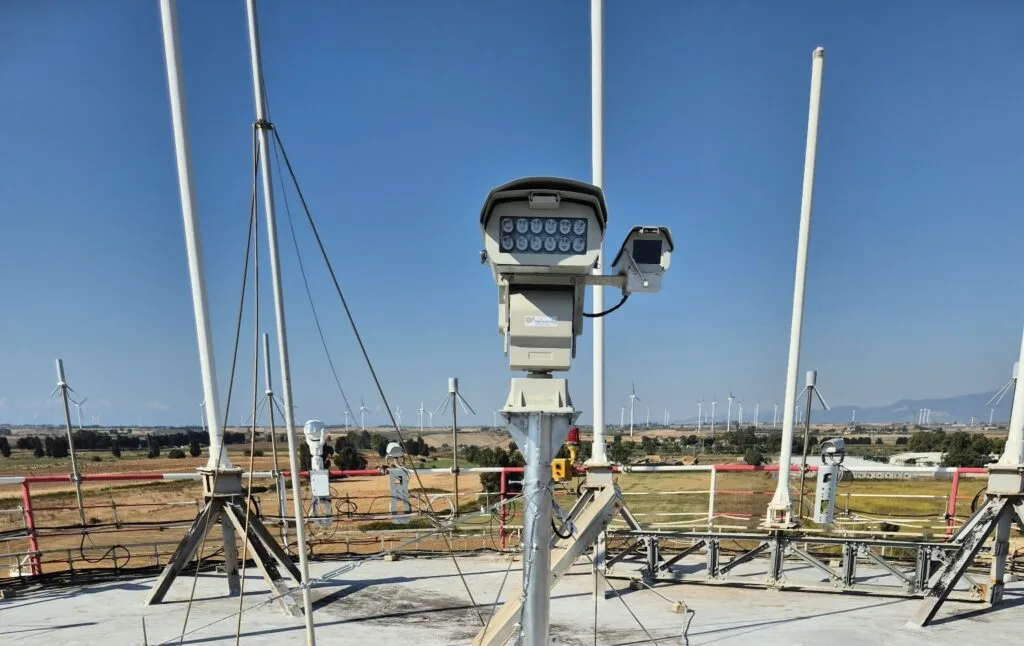
In sectors where air navigation systems operate, there is virtually no room for failure. Reliability forms the foundation of every design decision. This unforgiving environment is where Techno Sky, a subsidiary of ENAV Group, builds hardware and software infrastructure for air traffic management. The company's choice to construct their latest system around the Arduino Opta RS485 microPLC reflects how stringently they evaluated their technical options against the project's demands.
Techno Sky manages and maintains systems supporting air navigation services and develops technologies for the Air Traffic Management sector. Their research and development division creates solutions for air navigation service providers, airports, aviation authorities and organizations worldwide—systems engineered to withstand demanding operational environments.
The challenge: compact, reliable visual emergency signaling
Techno Sky was tasked with building a visual emergency signaling system for deployment within ENAV's Digital Tower environment. The specifications left no ambiguity: the system needed industrial-grade reliability, a small physical footprint, round-the-clock operational capability, Ethernet and industrial communication interfaces, built-in input/output functionality, and the ability to develop and maintain it without designing custom electronics from the ground up.
A fully custom hardware solution existed as an option, but would have introduced substantial delays and engineering complexity through design cycles, integration work, and validation testing—without necessarily delivering superior results. The team required a platform that would let them concentrate on the application layer and system integration rather than building the underlying controller infrastructure.
Opta: industrial capability meets software flexibility
Before settling on Opta, Techno Sky's R&D team examined conventional programmable logic controllers, purpose-built embedded systems, and single-board computers. The evaluation revealed that conventional PLCs lacked the development speed the project demanded. Purpose-built electronics would have introduced hardware design complexity. The single-board computers examined did not satisfy the project's technical specifications.
The Opta RS485 delivered integrated Ethernet and RS485 connectivity, relay outputs, and the adaptability of the Arduino programming environment and its library collection—all housed in a compact, DIN rail-mountable industrial package. Crucially, the platform permitted new capabilities to be added through software modifications alone, without requiring additional hardware components—a capability that proved valuable as the system matured.
From concept to operational system in under a year
In the final deployment, Opta functions as the primary embedded controller, overseeing signaling outputs, Ethernet communication, RS485 communication with peripheral systems, operational modes and timing sequences, monitoring functions, and communication validation and security. The system currently runs eight distinct signaling modes on a single controller—capabilities that Techno Sky determined would otherwise have necessitated extra hardware or a more intricate system design.
The principal technical difficulty encountered during development involved orchestrating communications, physical outputs, signaling sequences, and monitoring functions simultaneously. Techno Sky resolved this challenge through a modular software design and implementation of watchdog and communication-validation systems—methods intended to maintain a manageable code structure and predictable system operation. The Techno Sky R&D team conducted all development work internally, drawing on Arduino documentation, libraries, and development tools.
According to Techno Sky, work commenced in October and the system reached operational status in fewer than 12 months. A single Opta controller now manages more than ten primary control functions, operates continuously, and maintains the same architecture that was developed during the R&D phase through to the operational deployment.
Prototype and production on identical hardware
This continuity warrants particular attention. Many R&D teams prototype on one platform and switch to different hardware upon moving toward production. Techno Sky made no such transition. The Opta-based architecture created during research and development remained the architecture used in the operational system—a decision they attribute to their confidence in the platform's suitability for this application.
Opta enabled us to move rapidly from an R&D concept to an operational solution. Its industrial hardware, combined with the Arduino programming environment and library ecosystem, allowed us to integrate and expand multiple functions without increasing hardware complexity. The fact that we are retaining Opta in the operational system reflects our positive assessment of its effectiveness and reliability for this application.
Techno Sky
Expanding the scope of Arduino in ATM infrastructure
Techno Sky has incorporated Arduino platforms throughout their R&D work for several years, and this project demonstrates their deepening confidence in their selected Arduino product portfolio. Potential future applications being explored include monitoring systems, remote control capabilities, sensor integration, robotics, automated test equipment, and additional ATM infrastructure—a spectrum of possibilities that Techno Sky is currently assessing.
For organizations confronting comparable integration challenges—multiple control and communication functions, stringent reliability expectations, and urgency to transition from concept to operational deployment—Techno Sky's conclusion is straightforward: Opta proves well-suited when these functions must converge in a compact system without the burden of custom hardware development.
Source: Arduino Blog