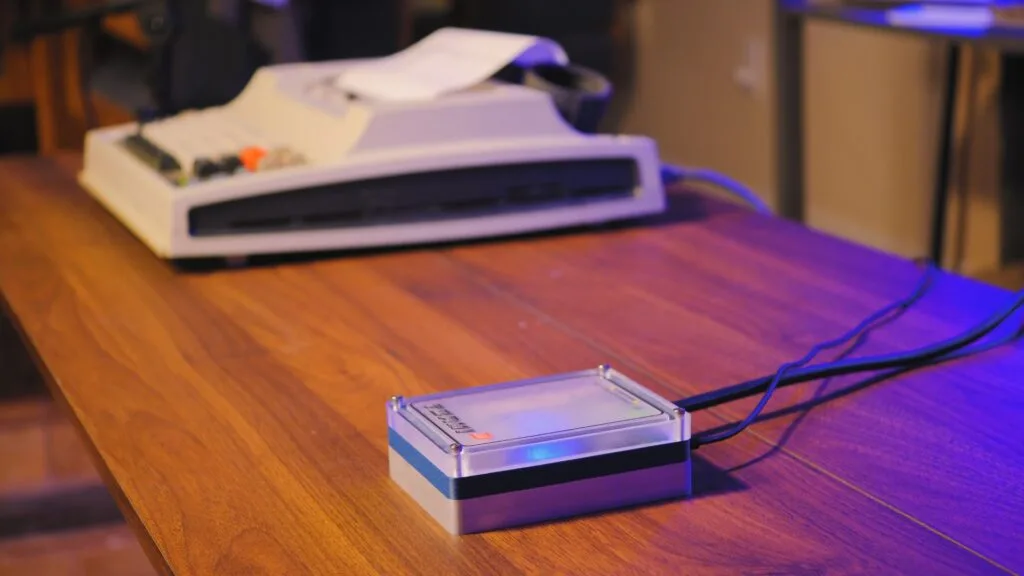
In 2026, asking a large language model for answers has become routine, yet most people still assume this requires internet access to distant data centers. The reality is different: LLMs can operate entirely on local hardware, generating responses without any network connection. Cameron Coward, who runs the Serial Hobbyism YouTube channel, demonstrated this possibility by pairing an Arduino UNO Q with a Texas Instruments Silent 700 terminal, a paper-based input/output device manufactured in the 1970s.
The Silent 700 (Model 745) was originally designed to work with minicomputers, connected either remotely via acoustic coupler or locally through RS232. Operators would type commands on its keyboard, and the computer's responses would print on thermal paper. Coward's project breathes new life into this vintage machine by connecting it to his custom device, Termi3, which enables the terminal to answer user questions in real time.
Termi3 marks the third iteration of Coward's creation. The earlier versions depended on internet connectivity, pulling answers from the Wolfram Alpha API. This latest version abandons that dependency entirely. Instead, the Arduino UNO Q (equipped with 2GB of RAM) runs Llama 3.2-1B, a local language model, on its Linux side without ever contacting a network. Communication with the terminal happens through bit-banging on the STM32 side, passing through a MAX3232 transceiver for voltage conversion before reaching the terminal's RS232 port.
The achievement itself is striking: fitting a functional LLM onto the compact and inexpensive UNO Q with just 2GB of memory. The trade-off is apparent in the model's limitations. The responses generated aren't always reliable, and sometimes lack coherence. Yet this unpredictability often adds charm to interactions with Termi3, making the vintage terminal surprisingly enjoyable to converse with.
Source: Arduino Blog