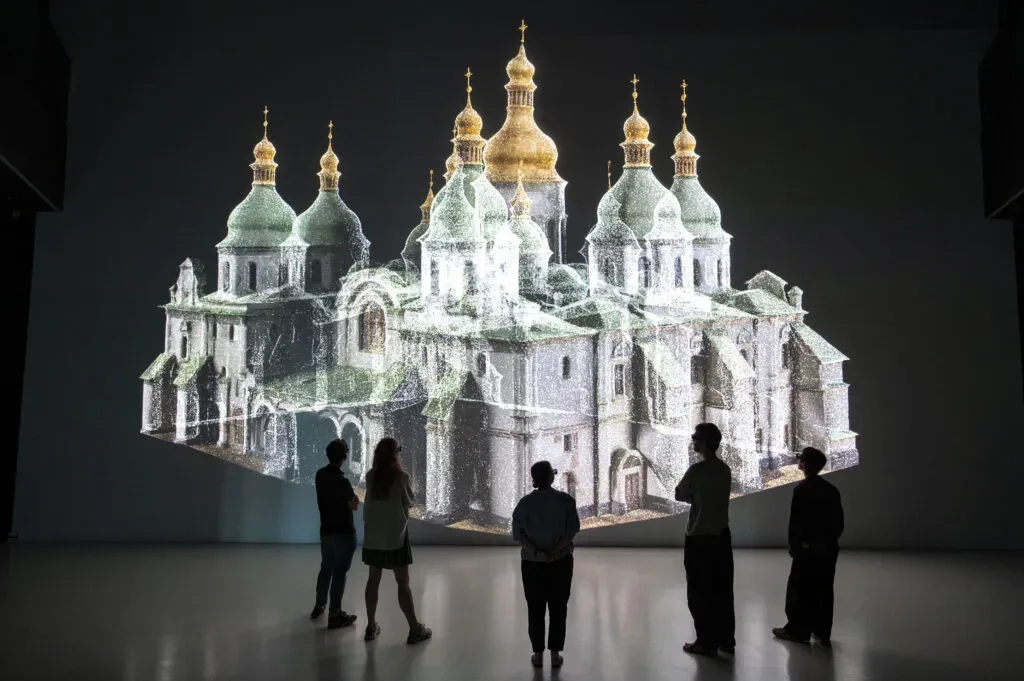
As Ukraine marks its Day of Dignity and Freedom on November 21 during the fifth year of conflict, Ars Electronica in Linz is mounting an ambitious digital memorial to the country's embattled cultural heritage. The exhibition, titled "Unbreakable Ukraine," occupies the venue's Deep Space 8K immersive environment and confronts visitors with the scale of destruction: more than 1,300 Ukrainian cultural sites have sustained damage since the war began, with nearly 400 now beyond repair.
The project, developed jointly by Italian immersive studio SARAVÁ Project and Ars Electronica, transforms high-resolution 3D scans of iconic Ukrainian buildings into an interactive journey through digital space. Visitors navigate detailed models of four historic landmarks: St. Sophia Cathedral in Kyiv and the Odesa National Academic Opera and Ballet Theater—both UNESCO World Heritage sites—alongside Vasyl Karazin University in Kharkiv and the Chernihiv Regional Children's Library. The exhibition also features the statue of St. George from St. George's Cathedral in Lviv, depicted battling the dragon as a symbol of Ukrainian resistance.
The technical foundation rests on years of preservation work by Ukrainian digital heritage partners. Skeiron has been documenting Ukraine's cultural sites through 3D scans and photogrammetry since 2016, accumulating data on over 270 locations. The Ukrainian Heritage Monitoring Lab (HeMo) has surveyed more than a thousand sites, building a comprehensive database of cultural losses. For the Deep Space 8K adaptation, the Ars Electronica Futurelab layered raw point cloud data comprising more than three billion laser points onto an illuminated surface model, achieving exceptional architectural detail.
Beauty Confronting Destruction
The exhibition's power lies in its dual presentation. Some structures appear as intact architectural masterpieces, while others bear visible scars of Russian bombardment. This juxtaposition creates what curators describe as a unique sense of urgency: the monuments displayed in Linz may simultaneously face attack, damage, or destruction in the real world. Presenters can move freely through the models, accessing "points of interest" that highlight specific elements alongside photographs and video documentation.
"'Unbreakable Ukraine' is an immersive journey created to celebrate Ukraine's extraordinary cultural heritage – and to carry its beauty forward. Because beauty is never only what we see. It is memory, knowledge, imagination, identity and human connection. To preserve beauty is to preserve its meaning," said Alessandro Simonetti, Creative Director of SARAVÁ.
From Festival to Permanent Program
The project builds on an earlier traveling exhibition that debuted in 2025, presenting 3D-scanned Ukrainian cultural sites within a walk-through cube constructed from LED walls. That iteration, developed by SARAVÁ based on scans from Skeiron and HeMo Lab and presented by BORISTENE Cultural Association, introduced the concept to international audiences. Now, following its premiere at the Ars Electronica Festival 2026, the Deep Space 8K version will become part of the Ars Electronica Center's regular programming beginning in 2027.
Fundraising for Educational Reconstruction
Beyond its role as cultural documentation, "Unbreakable Ukraine" supports a broader humanitarian mission. The exhibition partners with UNITED24, Ukraine's official fundraising platform, directing visitor donations toward the Education and Science program, which finances the reconstruction of schools for Ukrainian children.
Deep Space's Long Commitment to Heritage
Ars Electronica's Deep Space facility, which opened in 2009, has established itself as a venue for large-scale cultural preservation projects. The space has previously hosted immersive presentations ranging from gigapixel reproductions of world-famous artworks to stereoscopic 3D reconstructions of historical sites—from ancient Rome and Venice to the Pyramids of Giza. Recent projects include a virtual reconstruction of Linz's synagogue, destroyed by the Nazis, and the 2024 audience favorite "Notre-Dame Immersive." Many of these initiatives emerge from collaborations between the Ars Electronica Futurelab and the Ars Electronica Center.
Roland Haring, Technical Director of the Ars Electronica Futurelab, emphasized the philosophical approach underlying such work: "At the Ars Electronica Futurelab, we are not interested in technology as an end in itself, but as a means of creating new approaches to socially relevant topics. With immersive technologies such as Deep Space, we can open up perspectives for people that would be virtually impossible with traditional media. The artistic approach is crucial here: it translates technological possibilities into experiences that move us, make us reflect, and give these topics new social significance."
Source: Ars Electronica