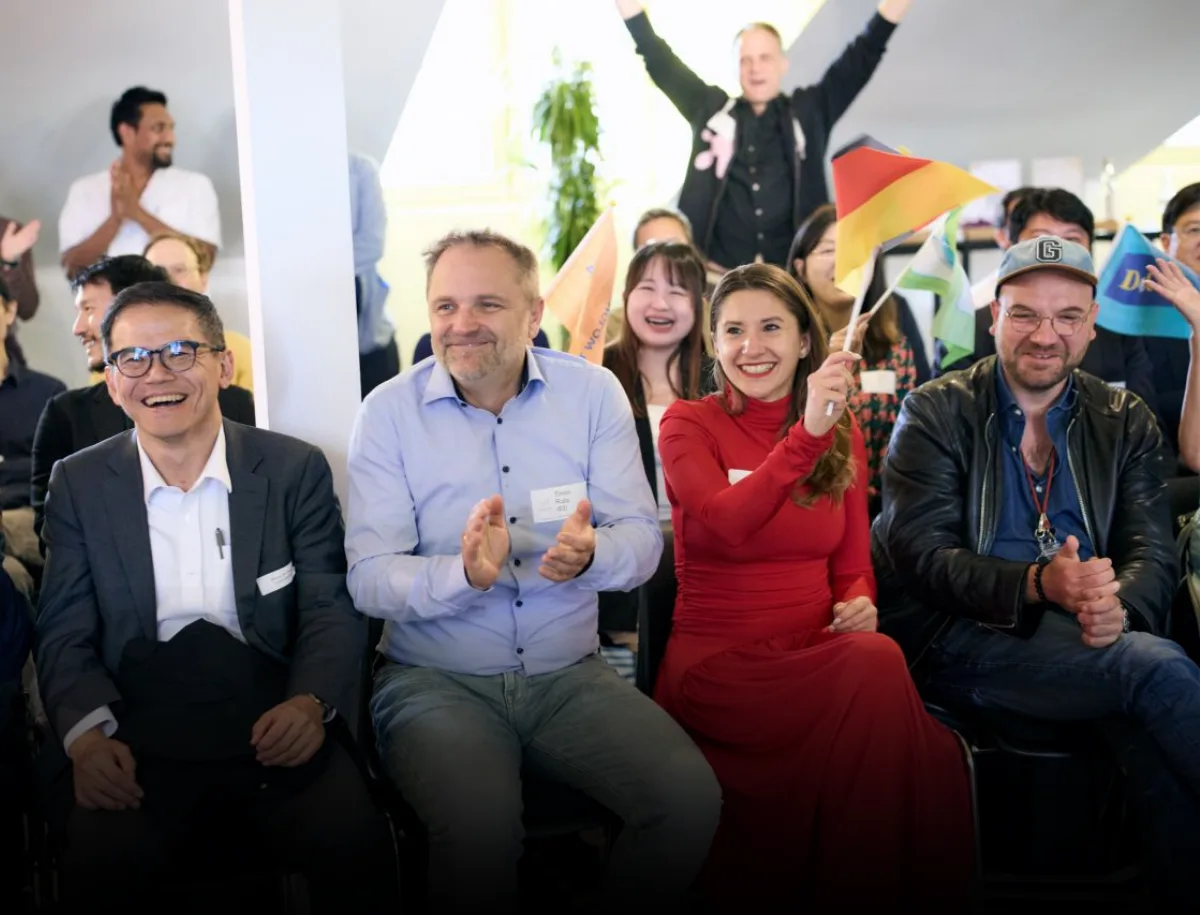
Within technology and venture capital circles, the word "serendipity" gets deployed frequently, conjuring images of chance meetings that spark billion-dollar ventures or perfect founder partnerships. Yet according to Ewa Emilia Geresz, who has spent recent years directing Venture Café operations across Warsaw and Berlin while building global connections, this narrative misses the mark. Serendipity, she contends, is not happenstance. Rather, it represents a form of infrastructure—something that requires intentional construction, ongoing upkeep, and careful design.
In conversation with Geresz, the discussion centered on how the Central and Eastern European region might move beyond its ingrained survival-focused approach toward a model emphasizing cooperation—one that could enable it to develop at the same pace as leading Western ecosystems.
From Poland and Germany, to Uzbekistan and Taiwan
For Geresz, fostering genuine connections requires moving beyond superficial gestures. At a recent Venture Café Warsaw panel addressing Polish-German technology cooperation, which Geresz moderated alongside panelists Lisa Brauer and Dr. Philipp Johannes Nolte, participants discussed a notable shift in how German enterprises and investors perceive Polish startups. Rather than viewing them merely as interesting companies to encounter at pitch sessions, German stakeholders increasingly recognize them as essential partners in technology and business development. The pressing challenge now involves converting this positive sentiment into tangible results: transforming preliminary conversations into actual pilot programs, paying customers, and sustained commercial relationships.
Having lived and worked in both Warsaw and Berlin, Geresz has witnessed a marked increase in partnership activity between these two cities. One notable effort involves the reactivated "Polish Tech in Germany" initiative, which brings Polish entrepreneurs, capital providers, and advisors to German conferences and events.
The scope of this work stretches well beyond the Polish-German axis. In Berlin, Geresz facilitated connections linking European innovation with Central Asian markets. During the Digital Uzbekistan – Germany showcase held at the Uzbek Embassy, CIC Berlin formalized a partnership agreement (MoU) with IT Park Uzbekistan, establishing pathways for talent exchange, international scaling, and ecosystem coordination between the two regions.
Geresz's efforts also extended toward East Asia. During a September Venture Café Berlin event, CIC Berlin entered into another partnership agreement, this time with Taiwan's Startup Terrace. The arrangement connects Berlin's entrepreneurial network with Taiwan's robust hardware and technology capabilities, facilitating market entry and investor connections for founders across both regions.
For Geresz, the signing of agreements in Warsaw, Tashkent, or Taipei represents merely the beginning. The genuine challenge emerges afterward: converting signed documents into functioning partnerships, operational prototypes, and fresh possibilities for entrepreneurs. Her fundamental conviction remains unchanged: authentic relationships emerge through deliberate system-building, not by accident.
Shifting competition to collaboration
When discussing the primary hurdle she encounters while fostering ecosystem connections, Geresz did not cite the typical suspects—insufficient capital or bureaucratic obstacles.
The most challenging is trying to change people's mindset to shift from competition to collaboration.
Ewa Emilia Geresz
Across numerous European metropolitan areas, ecosystem participants—ranging from accelerators to local government agencies—continue treating one another as competitors fighting for scarce resources. These "tiny battles" consume resources that might otherwise support collaborative endeavors. Geresz notes observing comparable patterns even within individual nations: "cities often compete for the same events, sponsors and media attention", fragmenting efforts that could advance the region collectively.
We are losing energy with these tiny battles inside of the ecosystems… Why are we competing who will do a better event for one city, let's collaborate and do one for the whole country.
Ewa Emilia Geresz
Yet the issue extends beyond insufficient networking opportunities. Geresz identifies a deeper trust deficit operating at the individual level. For generations, the prevailing narrative in regional nations—spanning Poland, Romania, and the Baltic states—emphasized catching up to Western counterparts. This historical context produced a generation of entrepreneurs distinguished by resilience and technical capability, yet also marked by caution and insularity. While an entrepreneur from the United States might broadcast their concept widely to gather input, a Central and Eastern European founder frequently operates quietly, developing their venture in isolation.
Engineering Serendipity: The power of intentional meetups
Shortly before our discussion at Startup Revolution AI Summit, Geresz participated in the panel "Beyond Networking: Why Startup Communities Matter More Than Ever", which Kristiana Kuneva of The Recursive moderated. During this session, social impact technology entrepreneur Berat Kjamili introduced the concept of serendipity when characterizing startup communities. He framed community as the fortune of occupying the same space simultaneously, then capitalizing on it: absorbing individuals' narratives rather than merely collecting their names.
Geresz subsequently returned to this terminology, sharpening its definition. She argued that serendipity transcends mere luck that befalls you—it represents something engineerable. In her formulation, "you will not experience serendipity if you don't decide to leave your home." This observation became the springboard for deeper exploration.
We cannot predict what is the outcome of the serendipity, but we can design it.
Ewa Emilia Geresz
The approach involves gathering entrepreneurs, investors, corporate representatives, government officials, and professionals from disparate sectors, then placing them in environments where their trajectories would not naturally intersect. The transformative element emerges when the setting is deliberately structured to dissolve compartmentalization: through selection of impartial locations, unified objectives, and participatory formats that necessitate engagement rather than passive observation.
A recent instance of this methodology occurred when a Taiwanese delegation was brought together with German ecosystem participants and several regional startups for a Venture Café presentation event. During a single afternoon, Geresz recalls, over 200 attendees from two innovation centers gathered in a conference space, exchanged information, presented prototypes, and discussed commercial approaches.
These curated encounters are far more than casual networking mixers; they give participants a clear reason to stay engaged beyond the initial hello.
Ewa Emilia Geresz
What bread has in common with cancer cells?
Consider a food-technology startup grappling with supply-chain management discovering a payments specialist prepared to jointly develop a transaction framework, or a medical-technology organization accessing a logistics partner's distribution infrastructure to expedite clinical research deliveries. Geresz illustrated this dynamic through an account involving a Japanese bakery and scanning technology.
"One Japanese bakery staff often struggled to tell, just by looking at it, which type of bread they were handling and how it should be packaged. To solve this, a team of engineers created a scanner that analyses the microscopic texture of each loaf." When a medical researcher encountered this innovation and engaged directly with its creators, she recognized that tumor tissue exhibits comparable structural characteristics—irregular and porous architecture.
"What if we fed medical‑imaging data into that system?" she proposed, immediately catalyzing collaborative exploration. The discussion rapidly progressed toward implementation, and the participants committed to developing a prototype that would repurpose the bakery scanner's pattern-recognition capabilities for identifying subtle tissue-density variations indicative of early tumors. The outcome was an economical scanner designed for preliminary cancer screening.
These instances demonstrate the significance of providing concrete purposes for gatherings. Defined initiatives, joint development sessions, and experimental collaboration agreements can transform momentary serendipitous encounters into substantive innovations. As Geresz stressed, "We need more trust. We need more collaboration to help each other," and deliberately constructed settings furnish precisely the framework necessary for cultivating such trust.
Running clubs & other unexpected connections
Beyond structured conference programming, the conversation also addressed a less conventional community: the Founders Running Club in which Geresz participates. "You are not meeting random people; you are meeting people who are tech‑savvy, aspiring and established founders, or seasoned operators from startups." The initiative began in 2022 with merely 4 participants on a San Francisco run. Currently, the Club encompasses more than 50k participants distributed across 45 nations spanning 5 continents.
The club incorporates an inherent system of mutual responsibility: participants encourage each other toward fitness and professional objectives simultaneously. "The community keeps you moving. When you hit a rough patch, the people around you push you forward and hold you accountable."
What particularly resonates with Geresz is the worldwide dimension. "Because it's in different countries and cities, you can show up somewhere for a weekend, join the community and run with them. It works whether you're in Berlin, Warsaw or elsewhere." Rather than arranging formal meetings, one can rapidly absorb the character and condition of an innovation hub simply by participating in a run.
If serendipity is too broad, like a city‑wide New Year's Eve party, you're unlikely to bump into the right person. The running club hits the sweet spot between a narrow silo and a chaotic crowd.
Ewa Emilia Geresz
The "Give Before You Take" Playbook
Examining CEE's trajectory and its cross-border partnership efforts, the path ahead appears less dependent on channeling additional resources and more focused on reshaping the foundational values governing how entrepreneurs, capital providers, officials, and ecosystem facilitators interact. Should the region embrace this understanding, the subsequent generation of technological advancement may originate not from a single metropolitan center, but from the convergence of Warsaw and Berlin, from the intersection of running groups and pitch competitions, and from making intentional chance encounters the standard rather than the exception.
Consequently, Geresz's guidance for those establishing cross-border community initiatives remains straightforward: "Give before you take."
In application, this involves engaging prospective collaborators with a defined benefit rather than a request. "I'm always first thinking, 'Okay, where can I be useful for you?'" she explains. By accumulating "goodwill capital," you establish a foundation to draw upon when assistance becomes necessary.
She also cautioned against imbalanced partnerships. "If someone only reaches out when they need something, they treat you as a tool. I'm a natural giver, but I stop after the third ask if it's one‑sided." Durable cooperation, in her assessment, demands reciprocity and commitment to long-term relationships.
Lessons for new community builders
Our discussion yielded several practical takeaways for those seeking to construct transnational technology communities:
- Shift the narrative – Reframe competition as a shared challenge; highlight success stories where collaboration led to tangible outcomes.
- Design the encounter – Create events with a clear, cross‑disciplinary purpose. Small, intentional gatherings often yield more serendipitous outcomes than massive festivals.
- Leverage existing partnerships – Use government‑funded programmes as scaffolding for deeper private‑sector ties.
- Blend formal and informal – Combine structured sessions with low‑key activities to foster trust in a more relaxed setting.
- Adopt a giver mentality – Offer resources, mentorship or venue space first, but don't forget to ensure relationships stay balanced.
Source: The Recursive — Events tag