A diner seeking a waiter's attention needs only one wish—and good hospitality delivers it. The best service feels effortless: a preferred table remembered, a room prepared before arrival, staff appearing at precisely the right moment. The guest experiences the outcome; the machinery stays hidden.
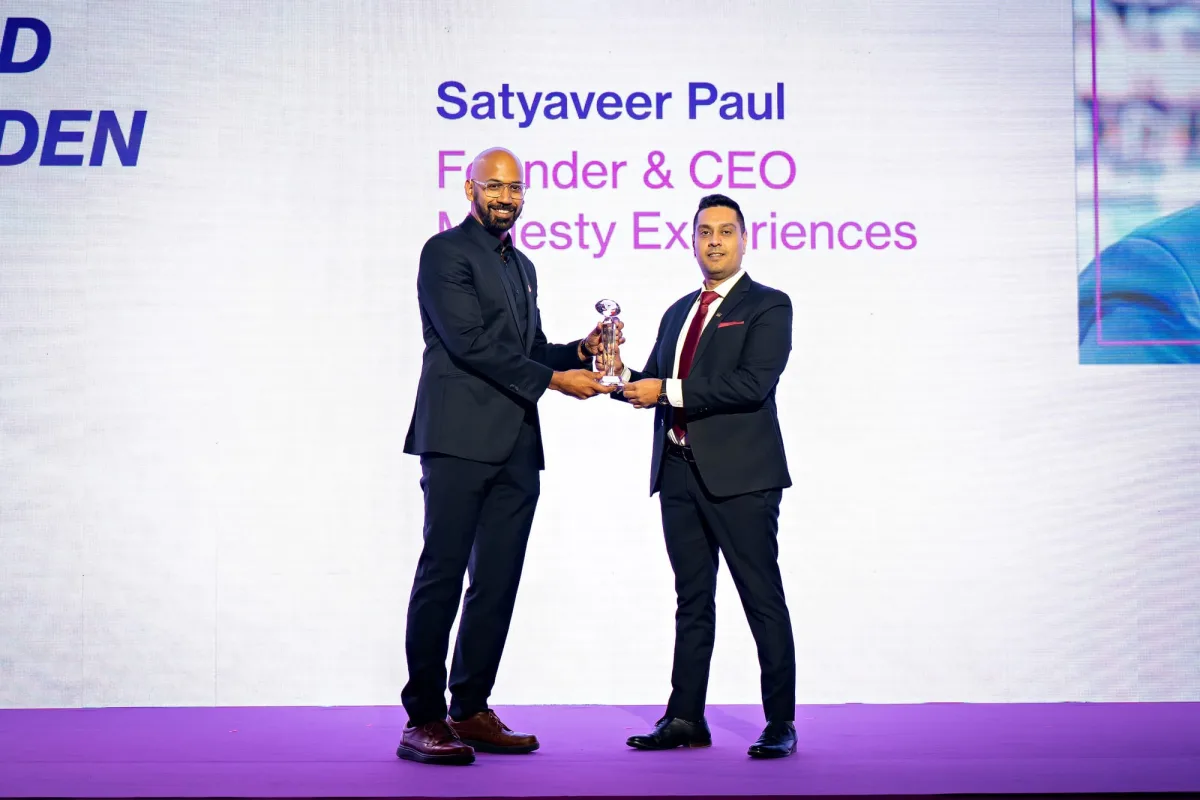
Majesty Experiences won the Startup Den competition at Future Hospitality Summit (FHS) World 2026 with a connected dining lamp that transforms the luxury restaurant table into an operational intelligence tool. The event, held at Madinat Jumeirah in October 2026, brought together nine finalists pitching solutions aligned with Dubai's D33 economic agenda, which targets doubling the emirate's economy by 2033 through advanced technology and digital transformation.
The jury included Capucine Jeunet Dourdin, executive director of sustainability at Jumeirah; Nisha Devadoss, venture investor at VU Venture Partners; and Khalid Alsatti, senior innovation specialist at UN Tourism. Across the competition, six distinct themes emerged about where hospitality technology is heading.
1. Restaurant tech is connecting guest experience with revenue intelligence
Satyaveer Paul, founder and CEO of Majesty Experiences, introduced an AIoT-powered lamp called LUMERIE paired with an operating system that gives restaurants real-time insight into service quality and operational performance. Guests request attention through the lamp while managers monitor service calls and response times. "The technology has to be invisible," Paul told the jury.
Rayn, another finalist, enters the customer journey earlier, enabling guests to explore a venue and select a table or space before arrival. The platform links those choices with reservations, deposits, pre-orders and business rules. "One hotel, many revenue spaces, one guest across all of them," founder Bhrijesh Patel explained during his presentation.
Together, these solutions move restaurant technology beyond simple transactions. The dining table becomes a data source revealing what guests value, how service unfolds and where commercial possibilities exist.
2. Digital humans must pass hospitality's human-service test
Slovak company Nettle AI builds conversational avatars for digital and physical settings, drawing expertise from finance and healthcare sectors. Co-founder Andrej Greguš framed the goal as delivering "a service at scale, covering both digital and traditional customer experience."
The startup demonstrated a digital human guiding guests through check-in and offering personalised support. In luxury hospitality, the handover from automated interaction to a team member can be as valuable as the technology itself. Success depends not on replacing people with machines, but on how the two collaborate within a hotel's service framework.
3. Connected hotels also need connected frontline teams
Integration is both a technical and organisational problem. MintHR consolidates employee workflows—onboarding, training, leave management, payroll preparation and operational reporting—positioning itself between hotel property-management systems and payroll functions.
The company emphasised Arabic interfaces, phone-number login and SMS communication, practical approaches to reach employees without corporate email or desktop access. Intelligence only becomes operationally useful when it reaches the person who can act on it, whether that is a manager adjusting schedules or a team responding to staffing changes.
4. Sustainability tech is bringing physical operations into the intelligence layer
EnthalpyX develops physics-aware AI to enhance cooling efficiency in existing hotels and commercial buildings without replacing HVAC systems. Co-founder and CEO Suyash Jain stated: "It's not the equipment, it's the control." The system progresses from monitoring to recommendations and supervisory control, keeping engineering teams involved as it learns a building's behaviour.
Bilqis GreenTech addresses another operational gap: measuring waste before materials are mixed or consolidated. Its B-Meter weighs, classifies and attributes waste to its source, supporting reporting, cost allocation and contractor reconciliation.
Both ventures connect sustainability with daily operating decisions. Cooling and waste become information streams that engineers, finance teams and facilities managers can leverage, extending hospitality intelligence beyond guest-facing software into the physical systems determining resource consumption and operating costs.
5. Wellness broadens what hospitality tech can deliver
Not all hospitality-tech opportunities focus on extracting operational data. SetLux's LuxeShower brings nature, relaxation and wellness content into an architectural glass experience for luxury bathrooms. Chief product officer Yehuda Knoch noted: "Differentiation is very important for us."
The business model is experience-driven: technology adds another dimension to a suite or spa beyond space, views and furnishings. This balances the intelligence-layer narrative. Operational efficiency is only part of the equation; the other is creating an experience guests are willing to pay for.
6. Hotel intelligence is becoming a layer above existing systems
2 Keys Revenue Intelligence is building a conversational commercial-intelligence tool that consolidates fragmented hotel data, helping teams analyse performance and make decisions. Founder Joyshree Chatterjee observed: "Hotels are drowning in data and starving for insight." The proposition transcends another dashboard—commercial teams should ask business questions without assembling reports from multiple systems.
SparkleHaze Innovations addressed the same fragmentation from a hotel-wide angle. Its AI copilot sits above existing systems and translates information into actions for general managers, housekeeping, operations and marketing. Chief Customer Officer Sharan Bhinder explained: "What we have done is we moved from data and dashboards to actual decisions. And most importantly, we are not asking them to replace their existing systems."
The overarching integration opportunity is making existing technology investments work together. The intelligence layer connects signals—arriving guests or spa-treatment interest—with decisions someone can act on.
The connected hotel is also a question of control
As information flows between more systems, three dimensions grow increasingly critical: what data is shared, where it travels and who can access it. Connecting reservations, guest preferences, staff workflows and operational intelligence creates a richer business picture but also a wider web of relationships between hotels, guests, employees and technology providers.
Data governance becomes part of the intelligence layer's credibility. A connected platform's commercial value depends partly on the operator's ability to understand and maintain control over those relationships.
Dubai's startup competition revealed a shared direction: hospitality is moving toward a more connected model where intelligence and human judgment determine how those connections translate into service, experience and business value.
Source: The Recursive — Events tag