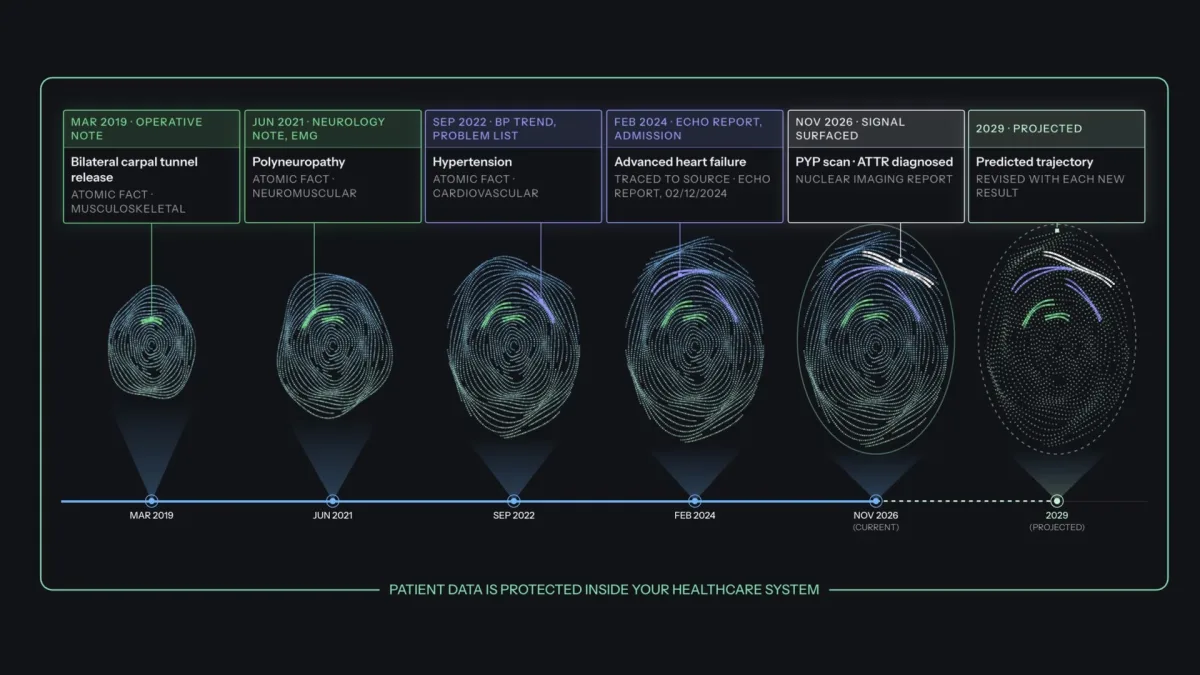
Dyania Health's Synapsis AI platform processed medical histories spanning up to 16 years for over 7,800 cardiac patients at Cleveland Clinic, operating entirely on the institution's own Nvidia infrastructure. The system analyzed records from patients who underwent aortic valve replacement procedures between 2005 and 2021, generating insights that enabled researchers to develop a predictive model for valve failure risk at three, five and ten-year intervals following surgery.
The technology addresses a fundamental challenge in healthcare data analysis: much of a patient's clinical information exists as unstructured text within physician notes and imaging reports rather than in standardized database fields. Synapsis processes this narrative content to respond to clinical inquiries while maintaining an audit trail connecting each answer to its source documentation. By running on servers within the hospital's own network perimeter, the system ensures that sensitive patient information remains on-site and never traverses external networks.
For the Cleveland Clinic study, the AI system addressed 88 distinct questions per patient, with the aggregated findings informing a risk stratification model for valve failure. Nvidia stated that manual chart review of this scope would have required years of clinician effort to complete. However, the research demonstrates the tool's capability to construct datasets and generate risk predictions rather than proving direct improvements in patient outcomes. Dyania has indicated that additional independent validation remains necessary before broader clinical claims can be substantiated.
Lars Svensson, who leads Cleveland Clinic's heart institute, characterized the initiative as "a promising step towards enhanced outcomes and more personalized care for patients." The decision-making authority remains with physicians, who review the AI system's supporting evidence before determining clinical actions. Cleveland Clinic disclosed its investor status in Dyania when the organization began piloting the tool for trial recruitment purposes.
The deployment reflects intensifying competition among major technology firms to establish footholds in hospital operations. Google Cloud introduced Gemini for healthcare this week, while Bunkerhill secured $55 million in funding for hospital-focused AI agents. Despite these substantial investments, demonstrable clinical benefits for patients remain elusive, and the medical community has expressed skepticism toward expansive marketing claims in this space.
Source: The Next Web