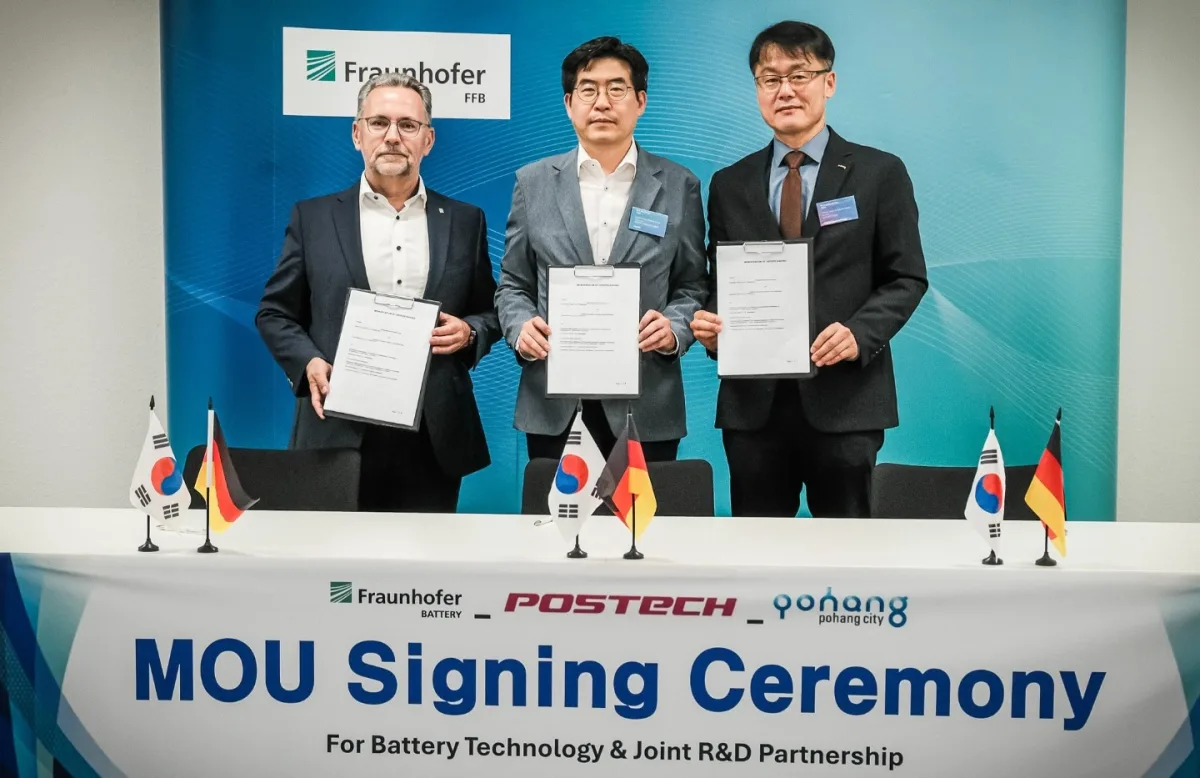
Two memoranda of understanding, inked at Fraunhofer FFB in Münster, mark the beginning of expanded cooperation between the Fraunhofer Battery Alliance and a trio of South Korean partners: the Korea Environment Corporation (K-eco), Pohang University of Science and Technology (POSTECH), and the City of Pohang. The agreements chart a course for joint investigation into battery technologies, manufacturing approaches, and end-of-life material recovery.
Materials, Manufacturing and the Circular Economy
The research agenda with POSTECH and Pohang spans the full spectrum of battery development: from materials suited to lithium-ion chemistries through emerging battery architectures, cell design, production techniques, material reclamation, and circular-economy frameworks. Pohang has committed to supplying administrative backing and funding mechanisms to facilitate engagement with regional enterprises and international research networks.
K-eco's involvement centers on recovering value from spent batteries. The partnership will examine methods for certifying and validating the quality of materials extracted from used cells, with particular attention to meeting the demands of the EU Battery Regulation (EU) 2023/1542.
A seminar held in Münster allowed the collaborating teams to present their current work and explore potential directions for coordinated research efforts.
Industrial-Scale Testing in Münster
The Korean delegation toured FFB PreFab, Fraunhofer's manufacturing facility in Münster-Amelsbüren, which provides the infrastructure needed to test battery cell production at scales and conditions mirroring real industrial operations. The facility allows researchers to evaluate novel cell designs, battery material formulations, and production methods in environments that closely replicate commercial manufacturing, enabling early assessment of whether innovations can be scaled to high-volume production.
Source: Battery-News