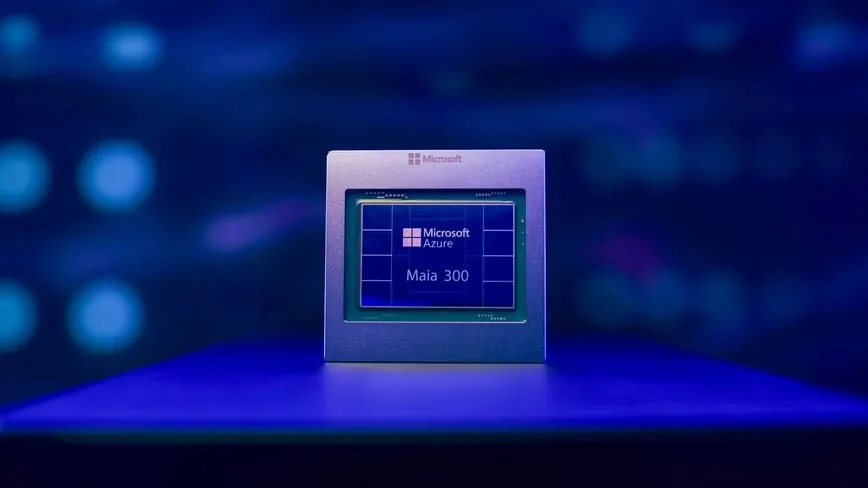
The technology giant announced on Monday that Maia chips will transition into the primary compute platform for its AI-driven products beginning in 2027. The announcement came alongside the reveal of the Maia 300, representing the latest iteration of Microsoft's proprietary silicon designed specifically for artificial intelligence workloads.
Deployment ambitions at the gigawatt scale suggest Microsoft could deploy more than one million Maia 300 units by 2027. The chip architecture focuses on inference—the computational task of executing already-trained AI models—with particular emphasis on supporting extended dialogues, complex reasoning, and autonomous agents capable of handling multi-stage operations.
Performance metrics indicate that for each megawatt consumed, the Maia 300 generates 40% additional tokens—the discrete text units produced by language models—relative to leading GPU alternatives, though Microsoft did not specify which systems served as the comparison baseline. A complete rack configuration delivers up to seven times the throughput of its predecessor, the Maia 200.
Each rack houses 96 chips and consumes approximately 167 kilowatts of power. In contrast, Nvidia's latest GB300 racks accommodate 72 GPUs while drawing roughly 142 kilowatts, according to Reuters reporting.
Technical Architecture
The Maia 300 employs a chiplet-based design, subdividing the processor into discrete functional modules for computation, memory management, and interconnect operations. The computational elements leverage TSMC's N2P manufacturing process, while each chip integrates eight HBM4 memory stacks.
It's basically delivering more intelligence for every watt, every dollar, and every byte of memory by optimizing across the entire system
Rani Borkar, who runs Azure hardware systems and infrastructure at Microsoft, told Reuters
Current Deployment Status
The Maia 200 is already operational in production environments. The chip currently powers Microsoft Copilot alongside OpenAI models and Microsoft's proprietary MAI models. By year-end, the Maia 200 will also support GitHub Copilot and Microsoft Foundry.
Industry Context
Microsoft's move reflects a broader industry trend among major cloud operators and AI developers seeking to reduce dependency on Nvidia's dominance. Google and Amazon have developed their own AI accelerators, while OpenAI partnered with Broadcom to create a custom chip.
Manufacturing capacity has emerged as a critical concern. The Information reported in August that Microsoft was negotiating with TSMC to secure production of more than 300,000 Maia 300 chips destined for 2027.
Microsoft plans to provide additional technical details during its Ignite conference in San Francisco next month.
Source: The Next Web