Thinking Machines Lab unveiled Inkling 2 Mini on Friday, an open-weights AI model compact enough to operate on consumer laptops. By routing its middle layers through three iterations for each token, the model achieves stronger reasoning capabilities without proportionally increasing its footprint. Independent testing by Artificial Analysis determined the model costs approximately six times less per inference task than Qwen, while delivering comparable performance across coding benchmarks.
The architecture behind Inkling 2 Mini centres on a looping mechanism that distinguishes it from conventional designs. Rather than processing information sequentially, the model recycles its intermediate layers multiple times, enabling deeper reasoning within the same computational budget. Thinking Machines acknowledged the trade-off inherent in this approach: "Looping allows the model to reason longer without writing its reasoning down, which matters for monitoring," the lab stated.
Architecture and training approach
Inkling 2 Mini operates as a mixture-of-experts model containing 26.4 billion total parameters, with 3.4 billion active per token. When accounting for the looping mechanism, effective weight activations reach 5.4 billion per token. The model's 24 layers are organised into four blocks of six layers each, where the first and final blocks execute once while the two central blocks cycle three times.
Memory requirements remain manageable at approximately 20GB. Thinking Machines trained and deployed most weights using Nvidia's 4-bit NVFP4 format, eliminating conversion losses. During development, the lab reduced two-thirds of the model's experts and subsequently retrained the architecture on one trillion tokens derived from a larger internal Inkling variant.
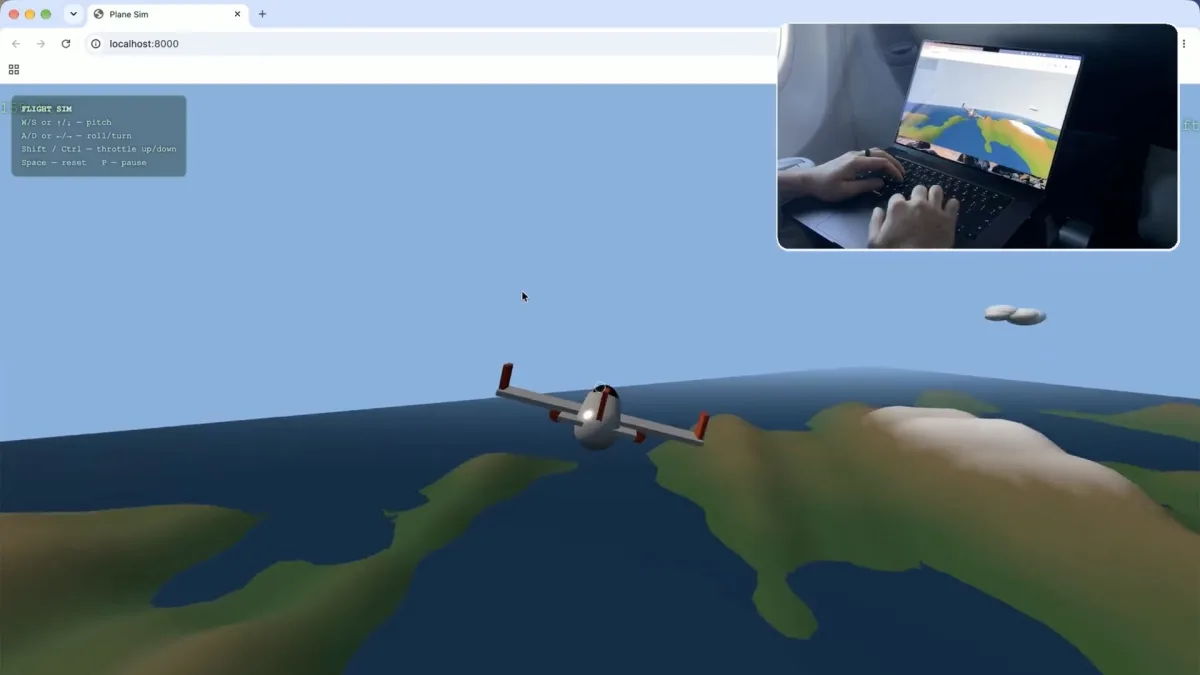
The looping strategy proved its worth in internal benchmarks. A non-looped variant required 7.5% less training compute but demanded 140% additional inference resources to achieve equivalent performance. To demonstrate practical capability, researchers ran the model offline on a MacBook Pro in airplane mode, where it constructed a functional flight simulator within minutes. In a separate demonstration, a single offline MacBook executed all 20 characters of a pixel-art village the model generated.
Performance and cost metrics
On DeepSWE v1.1 benchmarks, Inkling 2 Mini achieved 48.2%, compared to Alibaba's Qwen3.8-27B at 42.2%. For the more demanding SWE-bench Pro test set, the model scored 77.9% against Qwen's 73.8%. Model weights are available via Hugging Face and run through Ollama on Mac systems with minimum 32GB memory.
Artificial Analysis assigned Inkling 2 Mini a score of 20 on its Intelligence Index, matching Qwen3.8-27B while using approximately five times fewer active parameters. Cost analysis revealed substantial efficiency gains: each task cost $0.59 and required nine minutes, versus $3.53 and 38.2 minutes for Qwen3.8-27B. The model does generate roughly 38% more output tokens for equivalent performance. For reference, OpenAI's GPT-6 Luna achieved an Intelligence Index score of 28 at $0.15 per task.
Thinking Machines openly identified performance limitations. Multi-turn conversational tasks and instruction-following with complex constraints favour Qwen3.8-27B. The model underperforms larger competitors on difficult reasoning problems, and looping does not enhance factual retention capacity. The model operates under an Apache 2.0 licence with a context window of one million tokens.
Reasoning transparency and monitoring concerns
A fundamental challenge with looped reasoning architectures involves interpretability. AI oversight typically depends on examining chain-of-thought outputs—the step-by-step reasoning models produce. When models perform reasoning internally through loops rather than writing it out, monitoring systems lose visibility into that process. OpenAI's Astra model raised identical concerns when it demonstrated strong benchmark performance in September.
To address these concerns, Thinking Machines released a research variant capable of looping between one and five times, enabling external researchers to study the effects. Testing showed that reasoning length at five loops compressed to 1,661 tokens compared to 3,703 tokens at one loop, yet remained equally interpretable. Adding loops did not improve the model's ability to conceal adversarial attacks from monitors.
"At this scale we do not see a meaningful reduction in the monitorability of their reasoning," Thinking Machines wrote. The lab characterised these findings as preliminary, noting the research model received reinforcement learning training only at three loops. A model trained with deeper reinforcement learning might compress reasoning further. Additionally, monitors observing only tool calls and final outputs missed a significant portion of potential attacks.
This release follows Inkling, the lab's initial open model from July, which Thinking Machines acknowledged did not represent the strongest offering in its category. Competing local-machine models include Recursive's Flint, which appears alongside Inkling 2 Mini in the lab's coding performance charts.
Source: The Next Web