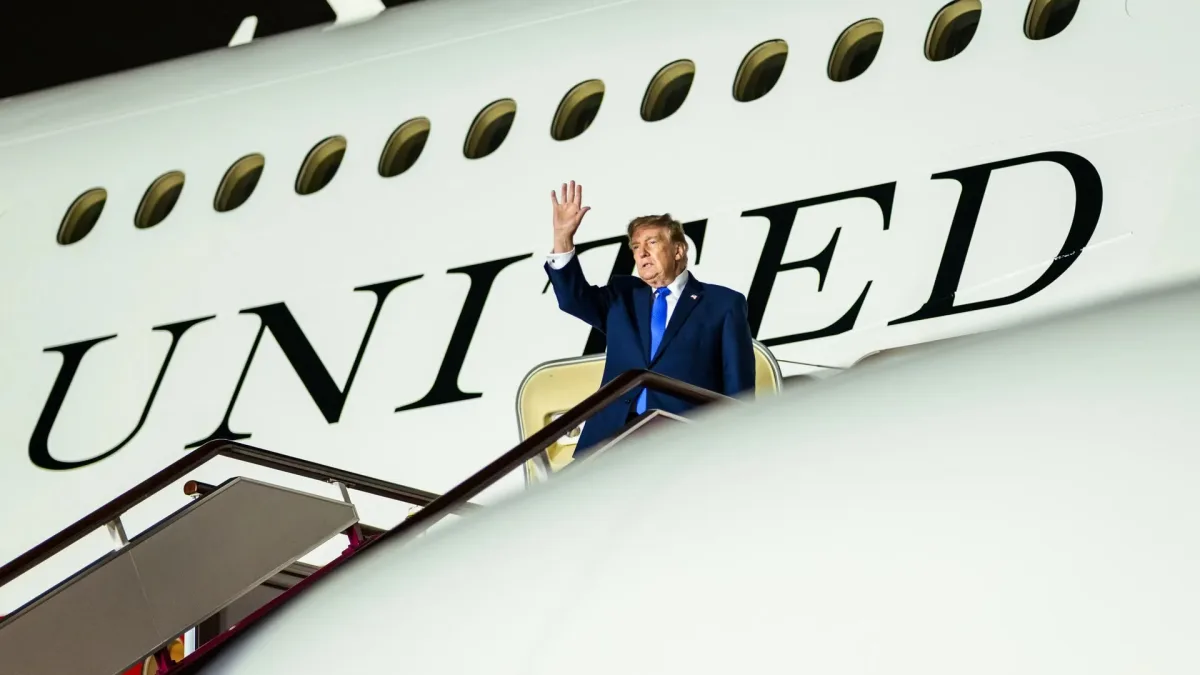
During a Friday White House press conference, President Donald Trump declared that American firms constructing data centres internationally would face significant taxation, though specifics on the mechanism remain unclear. Trump acknowledged he had not yet briefed his own administration on the proposal.
We're not going to allow companies to build data centers in other countries. If they do that, they can. But we're going to put a tremendous tax on them if they do it
Trump
Companies attempting such investments would encounter "tremendous penalties", Trump stated. He referenced one unnamed company seeking to establish operations in Finland as an example, though Google had announced in September a €13bn investment across four Finnish data centre sites.
Trump framed the initiative within his administration's "super intelligence" agenda, asserting that "whoever wins SI wins". He characterised the relocation of chipmaking capabilities abroad as "very destructive to our country".
Negotiating local benefits
Rather than opposing data centre development, Trump urged communities to extract maximum value from such projects. He highlighted that companies typically construct their own power generation facilities, potentially reducing local electricity expenses.
Trump referenced two unnamed local arrangements: one in Louisiana where data centre developers compensate teachers with $50,000 payments to secure project approval, and another location where residents receive $10,000 each.
It's okay with me. Make the deal. They have plenty of money
Trump
AI cooperation framework with Beijing
Trump stated that he and Chinese President Xi Jinping had agreed to establish "joint guard rails" for artificial intelligence development. He asserted that both nations represent the leading positions globally, with "there really is no third place", offering no elaboration on the arrangement. The two leaders had met alongside Russia's Vladimir Putin at a Shenzhen summit earlier in the week.
The US would participate in the new Quad SI accelerator alongside Australia, India and Japan only "on a limited basis", Trump stated, emphasising "we're keeping it in this country". He praised Anthropic's recent launch as "very successful" and expressed respect for chief executive Dario Amodei.
From his Asia trip, Trump announced that the Philippines and Malaysia had committed to adopting US technology and services for cloud infrastructure development.
Chip export restrictions remain
When questioned about relaxing chip export controls targeting China, Trump maintained that the US would permit only older semiconductor technology to reach Beijing. "We don't mind if none go", he added.
Trump stated that Nvidia's Blackwell chips must remain unavailable to China and other nations, characterising them as destined for obsolescence within two years. He reiterated his position that Jensen Huang should apologise and return to Nvidia, a call backed by more than 175,000 supporters.
Infrastructure and personnel changes
Regarding recent outages affecting banks and other institutions, Trump classified them as "separate events" stemming from system upgrades, including those related to super intelligence initiatives, which he characterised as "under control".
Trump described the air traffic control system as "ancient" and noted its 55-year age. The administration is requesting $50bn from Congress for air traffic control modernisation and intends to designate a single primary contractor for the new system.
When asked about his dismissal of national cyber director Sean Cairncross, Trump offered a terse explanation. Pentagon CIO Kirsten Davies will assume the role.
Because I didn't think that person was good enough
Trump
Source: The Next Web