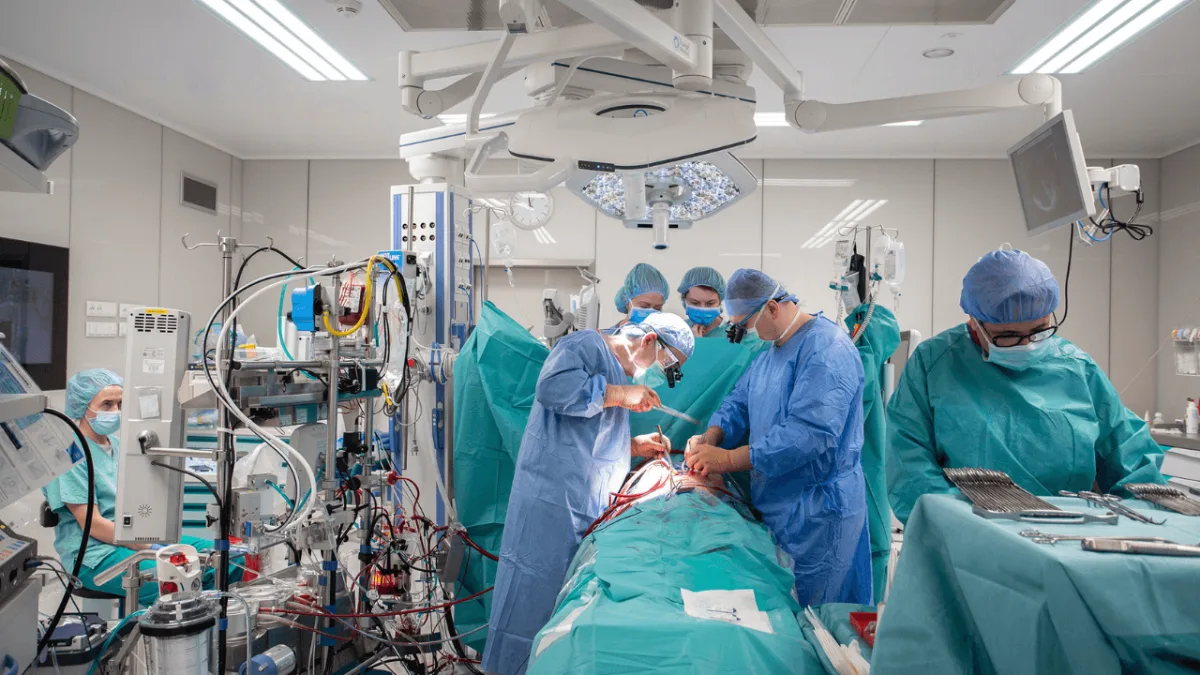
VitVio, a transatlantic startup established in 2024, is launching its Vetro surgical operating system in Poland through a collaboration with University Clinical Centre in Gdańsk (UCK), a major public teaching hospital. The platform leverages computer vision and artificial intelligence to monitor operating room activity in real time, handle administrative documentation automatically, and flag procedural bottlenecks.
The company was founded by Thomas Knox (CEO), Dr Peter Rennert (CTO), Maks Kozarzewski (COO), and Aleks Pajewski (CPO). Vetro combines computer vision with ambient sensing technology to generate a live, three-dimensional view of surgical spaces. AI agents then handle routine tasks including recording surgical milestones, spotting delays, and delivering real-time updates to hospital staff coordinators.
Starting with orthopaedics and neurosurgery
The initial rollout at UCK Gdańsk will cover a limited set of operating rooms in orthopaedic and neurosurgical departments. Following this test phase, VitVio and the hospital will assess outcomes before expanding to additional rooms. Medim, a Polish medical equipment distributor and healthcare solutions provider, is overseeing the installation.
Multiple cameras and environmental sensors will be installed in each participating operating room to gather spatial data. VitVio's Spatial Context Engine processes this information to build a dynamic 3D representation of the space. The system is engineered to track surgical procedures and their advancement rather than monitor individual medical staff.
Kozarzewski explained that the company will establish a performance baseline before assessing the pilot's effects on operating room efficiency.
It's too early for results at UCK Gdańsk. The pilot starts with a baseline, so we'll measure against how their ORs run today: throughput, on-time first starts, turnover time, overruns and the time nurses spend logging by hand.
Maks Kozarzewski, co-founder and COO of VitVio
VitVio indicates that research is underway with additional health systems to test the platform, with results to be made public following independent evaluation and approval from hospital collaborators.
Why 3D modelling matters in the operating room
Vetro differs from other surgical AI solutions that depend on single-camera feeds to detect specific moments. Instead, the system constructs a spatial representation of the entire surgical environment, monitoring personnel and instrument placement and tracking how procedures unfold. Kozarzewski elaborated:
Think of it as an extra team member in every room without a physical presence. It understands the whole room and takes tedious administrative work off the clinical team.
Maks Kozarzewski
Operating rooms present challenging conditions where people and devices frequently block individual camera views. By merging data from multiple sensors, Vetro can fill gaps in visibility, reconstructing portions of the room obscured from any single angle. This capability enables the system to pinpoint what causes delays, such as unavailable instrument sets or extended patient preparation.
Most questions that matter in an OR are about whether the right things are in the right place at the right time. Is the right tray next to the patient or still across the room? Is the equipment for the next step in position?
Maks Kozarzewski
From workflow monitoring to automated surgical documentation
Vetro's fundamental perioperative workflow functions are already operational in clinical settings. The platform automatically recognises surgical milestones, furnishes coordinators with a real-time view of operating room operations, and keeps teams updated as cases progress.
The company is rolling out bidirectional voice capabilities, enabling surgical teams to query Vetro and receive answers without leaving the patient's side. Instrument recognition functionality is also beginning deployment to help hospitals refine surgical instrument tray composition and utilisation.
Automated operative note generation is under development.
Voice interaction also paves the way for automated operative notes, combining what Vetro observes in the operating room with information provided verbally by the surgical team.
Maks Kozarzewski
VitVio envisions Vetro functioning as an integrated platform addressing multiple surgical operational needs, rather than deploying distinct systems for each function.
Protecting clinician privacy
Deploying cameras and machine learning in surgical spaces raises concerns regarding patient confidentiality, regulatory compliance, and potential surveillance of individual practitioners.
Kozarzewski underscored that Vetro documents surgical processes rather than assessing individual clinician performance.
Vetro records a timeline of each case: the same milestones nurses already log by hand, such as patient entry, incision and closure. It doesn't score or rank individual staff.
Maks Kozarzewski
Processing occurs on hospital-based servers where faces are obscured, text is stripped, and raw video is discarded. Only the surgical case timeline is transmitted in real time. The company notes that remaining de-identified sensor data is routinely purged within a brief window, typically seven days, though a limited set of anonymised video clips is preserved to validate system accuracy. Scheduling data derived from case history is aggregated across a threshold number of cases rather than used to evaluate individual clinicians. Voice features are voluntary, with each institution determining activation. VitVio functions as data processor while hospitals retain data controller status. Each hospital operates within its own isolated infrastructure in its geographic region.
Giving surgical teams more time for patients and training
At UCK Gdańsk, the deployment is intended to decrease administrative burden and enhance operating room utilisation, potentially enabling additional procedures within existing time slots. As a teaching institution, UCK recognises potential to allocate more time to clinical education.
As a teaching hospital, we want our surgical teams focused on patients and on training the clinicians who come after them, not on paperwork. What we learn in these first rooms will shape how we run the rest, and how we continue to set the standard for surgical care across Poland.
Dr Adam Sudoł, VP of Medical Logistics at UCK Gdańsk
We believe that intelligent AI-based solutions will play an increasingly important role in how healthcare is organised in the coming years, and UCK wants to play an active part in that transformation.
Jakub Kraszewski, CEO of UCK Gdańsk
Kozarzewski emphasised the importance of bringing the technology to Poland, particularly given the founding team's ties to the nation.
UCK Gdańsk trains many of the surgeons, anaesthetists and nurses who go on to work across Poland, so what happens in its operating rooms shapes surgical care far beyond Gdańsk. Every minute in a surgical suite carries clinical and financial weight, and too many are lost to paperwork and avoidable delays. Our job is to give that time back to clinicians, their patients and the next generation they're training. With Polish roots in our founding team, starting in Poland with a hospital of UCK's stand means a great deal to us.
Maks Kozarzewski
The challenges of bringing AI into hospitals
UCK Gdańsk joins VitVio's current hospital installations across the United States, United Kingdom, Mexico, and other European regions. In July, the company expanded Vetro access to hospitals and health systems in additional territories, including the Middle East.
Kozarzewski noted that adoption barriers are increasingly organisational rather than technical. Connecting with electronic health records systems can be lengthy, so VitVio permits hospitals to begin with Vetro using a temporary workflow while integration proceeds in the background. Compliance reviews and purchasing procedures can also delay implementations, particularly in government-funded healthcare networks. For publicly funded institutions, financial constraints represent the primary obstacle.
A new capital purchase can take a year to approve
Maks Kozarzewski
To mitigate this, VitVio seeks to reduce initial capital requirements, with the majority of expenses covered through hospital operating budgets.
VitVio recommends hospitals begin with a small number of operating rooms, measure results against a baseline, and scale following assessment.
We prove results in their own rooms and improve multiple challenges they face in the OR before asking them to scale.
Maks Kozarzewski
VitVio has secured $10 million in cumulative funding, including an $8 million seed round completed in October 2025, backed by Bek Ventures alongside LDV Capital and Balnord. Angel backers include Mati Staniszewski, co-founder of ElevenLabs.
Additional hospital deployment announcements are anticipated in the coming months.
Source: Tech.eu