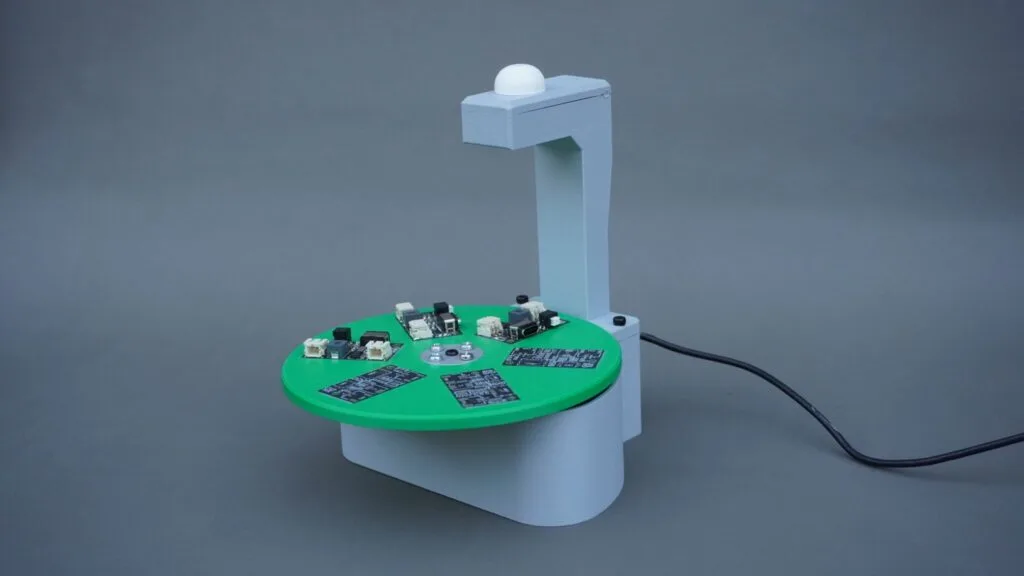
The space between one-off prototyping and high-volume manufacturing contains countless small operations producing PCBs in modest quantities—typically dozens to hundreds monthly. Yet quality assurance solutions tailored to this middle market remain scarce. Mukesh Sankhla has addressed this gap by engineering an accessible, cost-effective automated inspection apparatus.
The device represents a compact, benchtop-scale approach to vision-based PCB quality control. A rotating platform with six inspection positions moves through each slot automatically, enabling the system to detect missing components and surface defects. The inspection relies on camera input paired with YOLO vision models, which run through Edge Impulse.
What distinguishes this solution is its accessibility and minimal cost. Construction demands only an Arduino UNO Q board, a light source, a standard webcam, and a servo motor. The servo mechanism rotates the inspection platform beneath a fixed overhead camera mount. The STM32 processor on the UNO Q manages servo control, while the Linux environment executes the vision algorithms.
The entire apparatus uses 3D-printed components and remains fully customizable. The rotating platform itself can be modified to accommodate different PCB sizes and shapes. Users can easily adjust the turntable diameter or alter the number of stations to suit their workflow. As an example, a four-station configuration could enable sequential inspection of both sides of bare boards and both sides of assembled boards.
Source: Arduino Blog