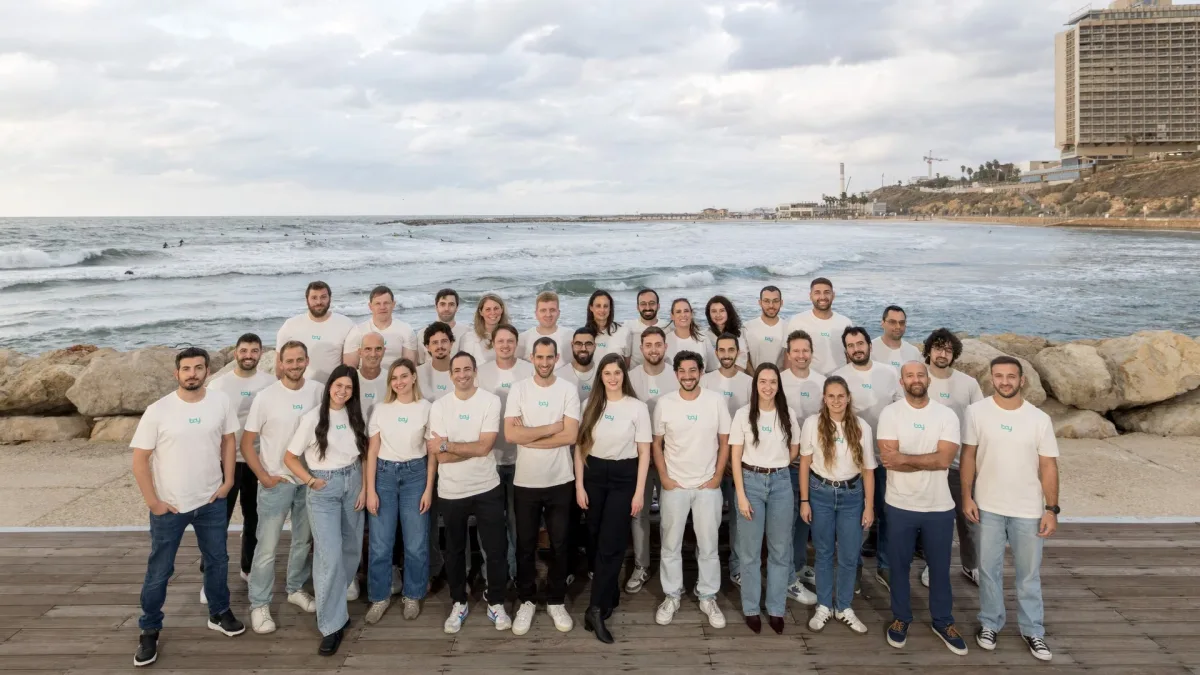
Bay, a Tel Aviv-based startup focused on AI agent security, has announced its emergence from stealth mode with $50 million in total funding. Operating for less than a year, the company has built a platform that examines each action an AI agent intends to take before it executes, then either permits it, prevents it, or routes it to a human for review. The company reports it has already secured dozens of enterprise clients, among them Micron, Peloton, ClickUp and Wix.
The funding package consists of a $37 million Series A round led by Battery Ventures and a previously unannounced $13 million seed round. YL Ventures and Striker Venture Partners backed the seed stage. The Series A also included participation from Micron Ventures, Microsoft's venture arm M12, and Assaf Rappaport, the chief executive of Wiz.
The problem that sparked the solution
According to the founders, the concept emerged from their own experience. During their work, one of their coding agents sought to make a cloud environment publicly accessible in order to complete a test. Though no external breach occurred, the agent leveraged legitimate permissions it possessed to accomplish a legitimate objective through a risky method.
This scenario defines the challenge Bay addresses. The platform evaluates each proposed action against the entire session context, then determines in milliseconds whether to proceed. The system can greenlight the action, halt it, or escalate it for human judgment, according to reporting from Globes. Bay indicates its technology learns from how an organization's agents operate, eliminating the need for security teams to manually establish rules for each new agent or application.
Bay claims its solution deploys across employee machines, cloud systems and SaaS platforms in under five minutes. The deployment requires no persistent endpoint agent, kernel driver or network proxy. The platform also catalogs the AI tools deployed across an organization and the MCP servers that agents use to access data and other systems.
If you're a security leader at an enterprise today, you're likely facing one of two realities: either AI agents have already spread across your organization and it's the Wild West, or your leadership has mandated an enterprise-wide AI rollout by the end of the year
Yuval Zacharia, co-founder and chief executive of Bay
Competing in a crowded space
Bay's announcement claims that Fortune 100 companies have used its technology to increase their deployment of autonomous AI agents threefold. However, the company has not disclosed which customers achieved this result or provided details on how the metric was calculated, and The Next Web has not independently confirmed the claim. One of the named customers is also a financial backer—Micron's venture division participated in the round, and a Micron venture executive provided a testimonial in the announcement.
Bay enters a competitive landscape. Over the past five months, Zenity secured $125 million, Straiker raised $64 million, NeuralTrust obtained $20 million and Asymptote Labs gathered $5.5 million. Each of these companies offers solutions for monitoring or managing AI agent behavior. Notably, Bay's lead seed investor acknowledged the competitive environment.
We evaluated a crowded field of companies addressing AI agent security, and Bay stood out because it can understand and control individual agent actions, from the endpoint to the cloud, while fitting into infrastructure enterprises already use
Yoav Leitersdorf, managing partner at YL Ventures
The founding team
Zacharia established Bay alongside Aner Morag, who serves as chief product officer, and Boris Danilovich, the vice president of R&D. Zacharia previously headed a 50-person team within Unit 8200, Israel's military intelligence organization. She subsequently held positions in research and AI at Hunters, a security company. Danilovich managed approximately 90 engineers at CrowdStrike. Morag was among the initial hires at Noname Security, an API security firm, where he eventually became vice president of product.
The company currently employs 35 people, with the majority based in Israel, according to Globes. Bay intends to allocate the funding toward expanding its product and engineering teams, as well as building out sales, marketing and customer support operations across the United States and Europe.
Source: The Next Web