The Arduino UNO Q Dream Lab Challenge, run jointly with DigiKey, invited makers to explore the capabilities of the dual-brain Arduino UNO Q board and Arduino App Lab. Among numerous inventive submissions, Engineering Scout stood out as one of the competition's top winners.
Real-world engineering often demands working with existing objects that resist easy measurement—a problem far messier than digital design. Identifying an unfamiliar fastener traditionally calls for specialized equipment: optical comparators, calipers, or thread-pitch gauges. Matthew Garza created Engineering Scout to streamline this reverse-engineering process through automation.
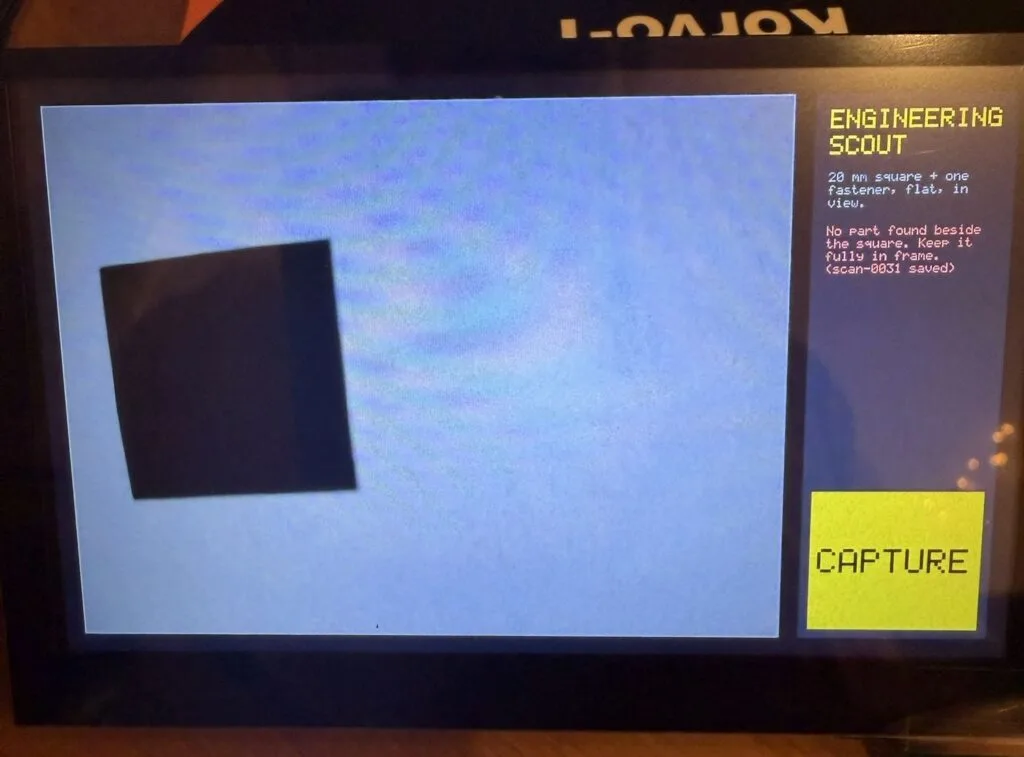
Engineering Scout is a compact device running on the UNO Q platform. It photographs physical objects, extracts dimensional data from those images, and generates a classification by combining measured values with logical inference.
The demonstration centers on identifying an unknown machine screw. The UNO Q captures multiple photographs as the user repositions the screw between shots, using a standard USB webcam. The screw sits atop paper marked with a printed square of known dimensions to serve as a scale reference. Pixel measurements from the photographs form the basis of the measurement stage. The system then applies reasoning based on established standards—for instance, assuming threads conform to common specifications like 1/4-20 or M6 rather than custom sizes.
Beyond screw identification, the project hints at broader applications. One possibility involves tracing an object's perimeter and converting it into a DXF file suitable for computer-aided design workflows.
The current prototype's accuracy hinges on image quality and remains sensitive to variables including lighting conditions, camera angle, object positioning, reference calibration, and environmental factors. Garza intends to enhance Engineering Scout by incorporating lighting adjustment systems and supplementary sensors designed to make the measurement phase more dependable.
Source: Arduino Blog