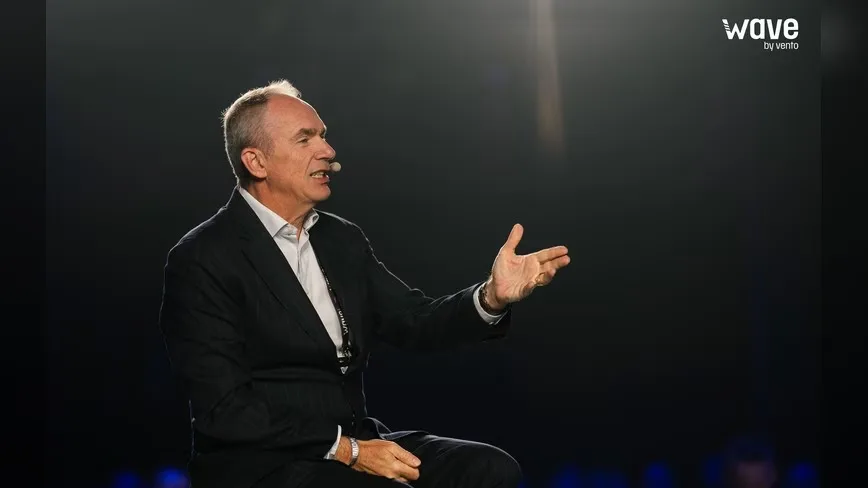
Scaling operations within Europe rather than watching startups depart to other continents remains a critical challenge, according to Jean-Christophe Laloux, who will lead the European Investment Fund from 1 January. Speaking at Wave by Vento in Turin on Friday, the incoming EIF chief stressed the importance of providing European entrepreneurs with sufficient capital to expand domestically.
It's not enough to innovate in Europe. You also must be able to scale in Europe. And that is really important on the notion of sovereignty.
Jean-Christophe Laloux
Laloux clarified that sovereignty in this context does not equate to protectionism or turning inward. Rather, it involves establishing robust European options in sectors where strategic independence matters most—spanning critical mineral supplies to digital security infrastructure.
Currently serving as director general for EU lending and advisory operations at the European Investment Bank, Laloux identified a significant shift in where capital constraints now bite. The real bottleneck, he explained, has shifted from the earliest funding stages toward the expansion phase, particularly the growth rounds between Series B and Series C financing.
Closing the scaling gap
The Tech Champions Initiative was established precisely to address this funding gap. The initiative operates as a fund of funds with a total size of nearly €4bn, drawing backing from six member states alongside the EIB Group. Its strategy focuses on investing in venture funds with individual sizes around €1bn—large enough to deploy substantial capital in maturing companies.
To date, the initiative has committed capital to 12 separate funds, a figure that represents nearly triple the number of €1bn-scale venture funds operating across Europe just five years prior. The portfolio companies held by these 12 funds include 15 European unicorns.
Laloux signaled that a second phase of the initiative will likely launch in November. This expansion will broaden the fund's reach by also backing smaller vehicles managing between €300m and €500m, recognizing that not all European innovation hubs have access to billion-euro funds. The second phase will additionally introduce a co-investment platform enabling institutional and private capital to participate alongside the primary funds.
Italy's participation
Italy has committed €150m to the Tech Champions Initiative. Funds supported through the program have subsequently deployed nearly €600m across seven Italian companies, with three of these investments involving international co-investors. According to Laloux, this pattern demonstrates that the Italian startup ecosystem has begun attracting attention from global venture investors.
Venture debt and early-stage support
Beyond traditional equity investment, the EIB Group extends venture debt financing to emerging companies. This lending structure typically includes a grace period of at least five years before repayment obligations commence. Rather than charging conventional interest rates, the lender receives warrants or comparable instruments that tie returns to the company's eventual performance. The group additionally manages the equity component of the European Innovation Council's support for pre-commercial stage ventures.
Deep tech momentum and sectoral focus
Deep technology sectors across Europe have expanded dramatically in valuation, climbing from approximately €1tn five years ago to €4tn currently—a growth trajectory outpacing virtually every other economic segment. Laloux highlighted climate solutions, security and defence capabilities, space technologies, and biotechnology as the primary drivers of this expansion. Funds receiving EIB Group backing have supported ventures such as Isar Aerospace, whose Spectrum rocket completed a launch from Norwegian territory.
Among these sectors, security and defence—encompassing cybersecurity dimensions—has witnessed the most pronounced capital growth and valuation increases over the past twelve months. Looking ahead, the EIF intends to concentrate resources on four domains where Europe maintains competitive advantages: artificial intelligence, health and biotechnology, security and defence, and cleantech.
Regarding artificial intelligence specifically, Laloux emphasized that Europe cannot afford exclusion from this transformative technology, given its potential to enhance productivity across industries. He cautioned against both an absence of regulatory frameworks and excessive regulatory burden that might stifle development. The EIB has allocated €3bn toward supporting the EU's AI gigafactories initiative.
Source: The Next Web