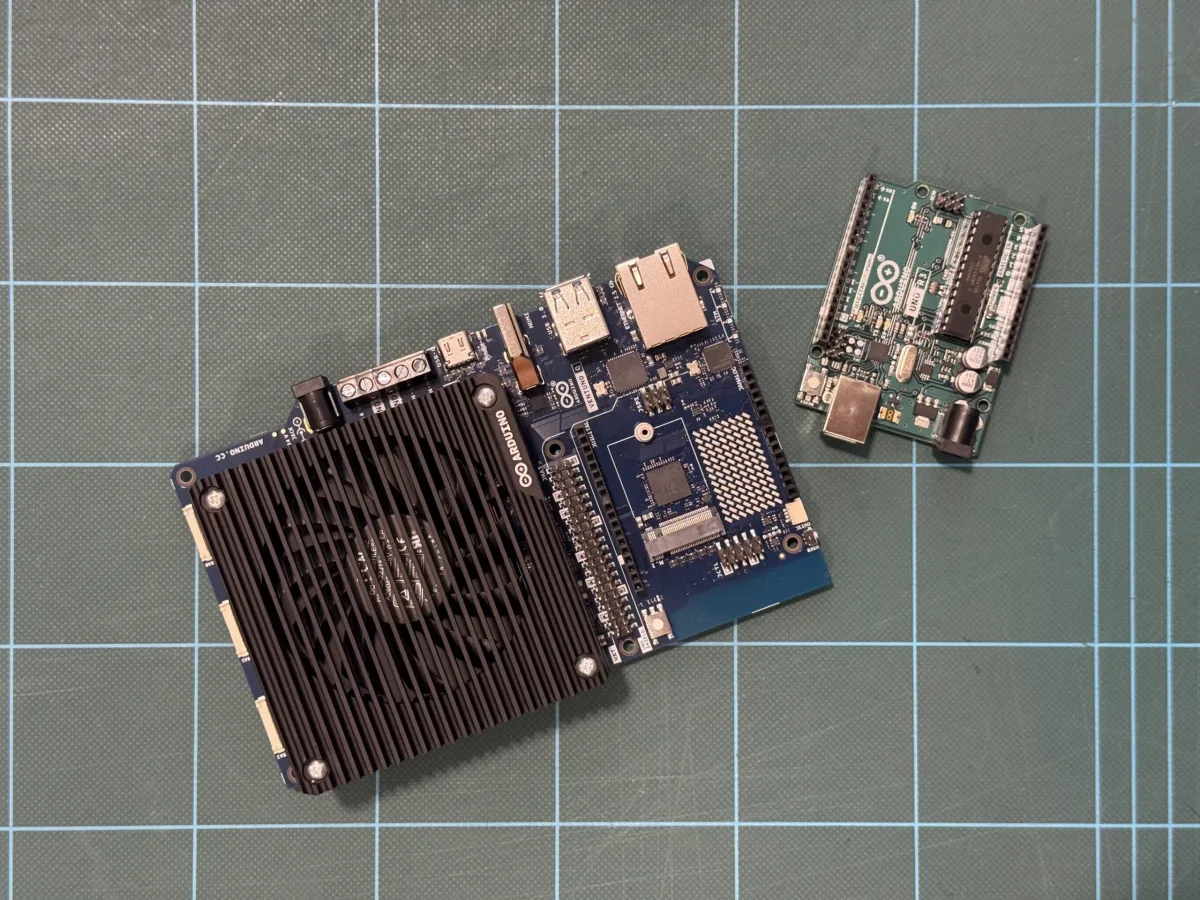
Two circuit boards sit side by side on a desk, both bearing the Arduino name and logo. The resemblance ends there. One is an early Arduino UNO Rev3 built around a Microchip ATmega328P microcontroller from the 2000s—a tiny piece of silicon that sparked the maker revolution. The other is the Arduino VENTUNO Q, powered by a Qualcomm Dragonwing IQ-8 chipset with an eight-core CPU and an NPU capable of reaching 40 dense TOPS. Despite their vastly different internals, both boards share the same pin headers and embody the same underlying design philosophy.
The numerical gap between them is striking. The original ATmega328P, an 8-bit AVR RISC core running at 20MHz, can theoretically handle about 8 million operations per second. The Dragonwing IQ-8275 reaches 40 trillion operations per second. Divide one by the other and you arrive at the headline figure: five million times more powerful. Yet this simple arithmetic masks a more complex reality about how computing performance is actually measured and compared.
The trap of incomparable metrics
Modern processors handle mathematics in different formats—think of them as different computational currencies. Small integer operations (INT8 or INT16) used in AI hardware require fewer resources than high-precision floating-point calculations needed for physics or navigation. A chip optimized for basic integer math can appear unremarkable when forced to handle complex decimals. Marketing materials for AI accelerators typically quote small-integer performance, while estimates for older chips like the ATmega328P derive from general-purpose clock cycles. Comparing these figures directly is like converting between currencies without an exchange rate: the resulting number may seem dramatic but offers no meaningful like-for-like comparison.
A fair performance comparison requires both chips to execute the same operation on identical data and produce equivalent results. The mathematical foundation of modern machine learning—multiplying two numbers and adding the result to a running total—provides an ideal benchmark. This operation, called multiply-accumulate or MAC, repeats millions or trillions of times to power image classification, voice recognition, and autonomous navigation. All these tasks reduce to the same underlying math at different scales.
Testing the real difference
Image classification offers a straightforward test case. Standard digital photos are cropped and resized to 224 × 224 pixels across three RGB color channels, creating an input array of 150,528 individual pixel values. Each color value becomes an 8-bit quantized integer between 0 and 255. Running one photo through a vision model containing roughly 100 megabytes of parameters generates a workload of 8 billion total operations—4 billion MAC steps.
The VENTUNO Q is designed to process roughly 5,000 photos every second. At that rate, analyzing a single photograph takes milliseconds. The original UNO Rev3, by contrast, would require about 17 minutes to analyze the same image. To process the 5,000 photos that VENTUNO Q handles in one second, the UNO Rev3 would need approximately 58 days. Starting on January 1st, it would not finish until late February. Within this benchmark framework, the performance ratio remains five million to one.
Why the numbers tell only part of the story
There is a fundamental catch: the UNO Rev3 cannot actually run this benchmark. The vision model requires roughly 100 megabytes of memory to store its parameters. The ATmega328P contains only 32 kilobytes of flash memory and 2 kilobytes of RAM—wholly insufficient. The "58-day" calculation assumes infinite external memory attached to the older board, making it a thought exercise rather than a practical measurement.
The real story is not that the old chip is simply slower. Rather, an entire category of work has shifted from impractical on earlier hardware to routinely achievable on modern AI platforms. No amount of patience can stretch 8 kilobytes of memory into 100 megabytes. Genuine technological breakthroughs rarely manifest as "the same capability, faster." Instead, they open entirely new categories of work that were previously impossible.
What actually matters
While the five-million-fold arithmetic advantage is real, the significance of VENTUNO Q extends beyond raw compute performance. A key contribution is making edge intelligence more accessible by reducing barriers to experimentation and development. The goal is helping developers transition from exploring AI software to building physical AI systems.
Whether toggling a GPIO pin on an 8-bit ATmega or deploying a computer vision model on a modern NPU, both boards follow a similar development philosophy: connect the hardware, open an accessible development environment, and start building. That emphasis on developer accessibility matters most. Despite enormous differences in compute capability, both are designed to provide an approachable entry point into hardware development and experimentation. Preserving accessibility while dramatically expanding compute capabilities represents a significant engineering achievement. Making AI technologies more accessible helps more people move from using AI tools to building AI-enabled applications of their own.
Source: Arduino Blog