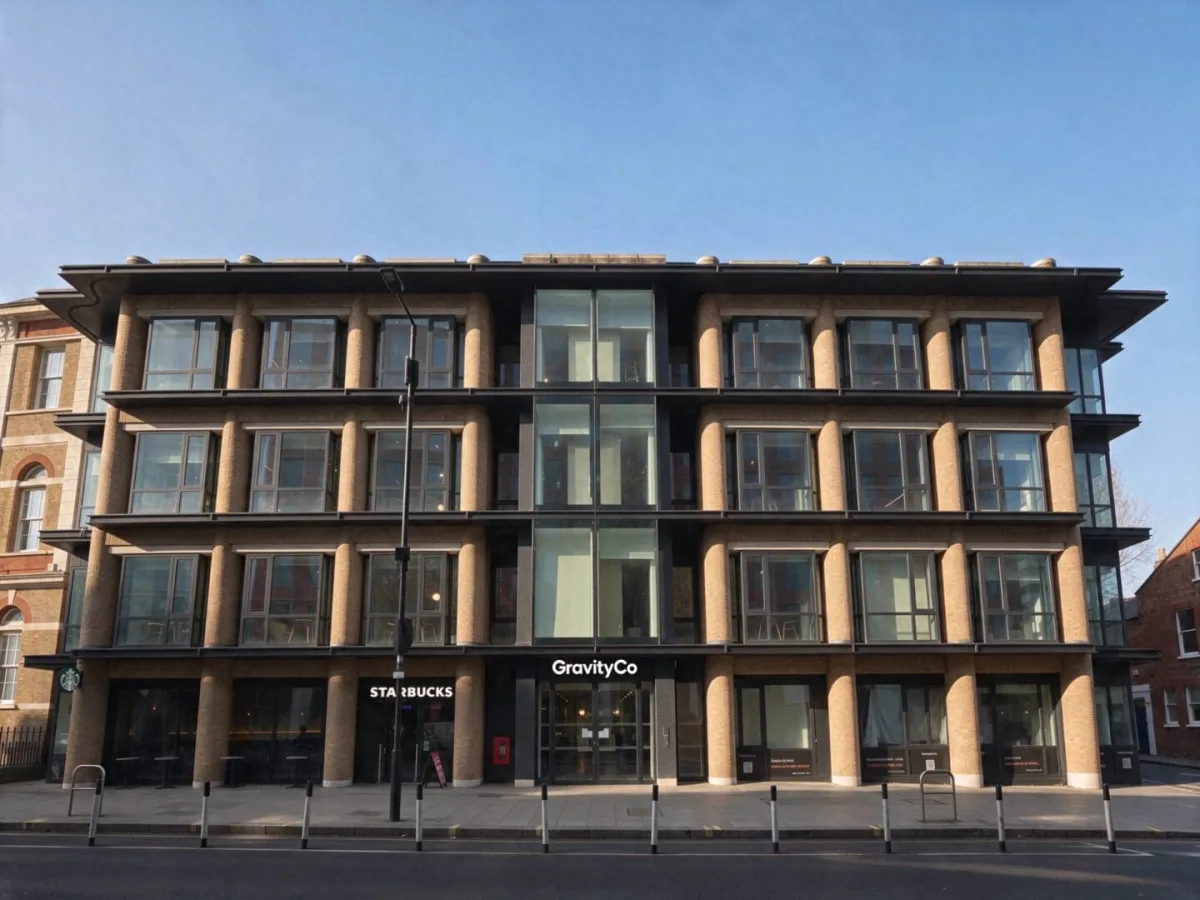
Riccardo Tessaro and Susanna Rock founded Gravity Co in 2017 to reimagine how young professionals live in London. The company operates fully furnished, all-inclusive rental homes powered by AI-driven operations and a resident platform that connects technology, hospitality and residential property. Its latest £4m funding round brings total capital raised to £8m, marking a transition from proving the business model to scaling it across the capital.
Two new London buildings—The Weymouth in Marylebone and 200 Hammersmith Road—have just opened, adding 142 homes to Gravity Co's portfolio. The company expects these openings to double its annualised revenue and projects reaching group-level profitability by Q2 2027, with £45m in annual revenue targeted by 2030.
From Proof to Scale
The latest funding round represents a critical inflection point for the business. Beyond financing the two new London buildings, the capital is being deployed to strengthen the Gravity Co brand through digital channels and community programming. Additional revenue streams are emerging from strategic brand partnerships and resident events, diversifying income beyond rental income alone.
Tessaro explains that the raise marks the company's evolution: "This raise marks Gravity Co's move from proving the model to scaling it. The capital has already been put to work: it funded the launch of our two newest London buildings, adding 142 homes to the portfolio, and it gives us the platform to accelerate our pipeline of further openings across the capital."
Technology as Operating Foundation
Rather than layering technology onto a traditional property business, Gravity Co has built it into every operational layer. Connected IoT systems enable centralised portfolio management from the London headquarters, flagging issues in real time and deploying teams where needed rather than tying staff to individual locations. This approach keeps operating costs structurally below those of traditional landlords while maintaining responsive resident service.
AI integration spans the entire resident journey. Lead qualification, maintenance triaging, marketing optimisation and performance reporting all run through machine learning systems, allowing a lean central team to drive growth without proportional overhead increases. According to Tessaro, "Technology is built into how we operate, not added on top. We continuously gather insight from residents to refine our service, and from prospective tenants to sharpen our marketing and shorten the path from enquiry to move-in."
AI in Action
- Lead qualification: AI screens every inbound enquiry before reaching the sales team, enabling three staff members at headquarters to drive more than 90% of bookings across six London locations
- Resident maintenance: AI handles initial conversations, gathers details and routes jobs to appropriate in-house teams or contractors, with operations oversight ensuring faster resident response and fully scoped work orders
- Marketing: Campaigns are stress-tested against AI-generated resident profiles before launch, refining creative and targeting to maintain competitive customer acquisition costs
- Reporting: Live performance dashboards consolidate sales and marketing funnel data, enabling decisions based on current information rather than month-end snapshots
Filling a Market Gap
London's rental market remains fragmented, with tenants navigating unfurnished flats, multiple utility contracts and inconsistent landlord experiences. Between short-stay hotels and traditional long-term lets, no consistent branded option existed for people staying three months to two years. Gravity Co addresses this gap with a standardised, high-quality product: fully furnished homes, all bills and Wi-Fi included, cleaning services and access to a resident community, all under a single monthly price.
The core audience comprises young professionals relocating to or already living in London, alongside international students. Corporate partnerships currently represent around 15% of residents, with the company targeting 25% by the end of 2027. Tessaro notes that the offering removes relocation friction: "With one all-inclusive monthly price, residents know exactly what they will pay from day one, with no hidden set-up costs."
The resident experience begins before arrival. Every home can be reserved online within minutes, supported by photo libraries, 3D tours and video walkthroughs of individual units, allowing people to book without in-person viewings. Once moved in, residents use the app to connect with neighbours, join events programmes and report maintenance issues, which are typically resolved within 48 hours.
Timing and Location Strategy
Three structural shifts have aligned to create the right expansion moment. The Renters' Rights Act, in force in England since 1 May 2026, abolished Section 21 "no-fault" evictions and replaced fixed-term tenancies with rolling ones. While disruptive for much of the market, this regulatory change validates Gravity Co's model: the company was built for flexibility, with residents already able to leave on one month's notice. Traditional landlords now face pressure to build these capabilities from scratch, driving more owners to let entire buildings to specialist operators rather than manage hundreds of individual tenancies.
Resident demand is also shifting. People increasingly seek the flexibility and service of hospitality combined with the space and community of a genuine home. In a supply-constrained market, a consistent, professionally run product stands out. Additionally, Gravity Co is introducing hybrid management agreements that pair guaranteed base rent for owners with a share of upside, offering landlords both fixed income security and operator-led performance benefits—a combination still uncommon in UK residential.
Location selection follows disciplined criteria. Every building must sit within a 35-minute public-transport commute of London's main business districts and within a ten-minute walk of a Tube station, in a neighbourhood with strong retail and ideally an established office presence. The company assesses sustained rental growth, positive population inflows, supply–demand imbalances across the wider rental market and tracks where major employers are opening offices.
Path to Profitability
The two new openings are expected to double annualised revenue, with the company targeting profitability by Q2 2027. Growth will be driven by existing portfolio performance—currently trading at 96% occupancy excluding Hammersmith—with the Hammersmith location expected to stabilise at 95% occupancy by the end of Q2 2027. Beyond that, regulatory and tax changes continue shifting how owners and investors view the sector, translating into a substantial increase in Gravity Co's pipeline.
Challenges remain real. This sector requires significant capital and deep networks of owners, developers and investors. Gravity Co's current challenge is not finding opportunities but being selective about the right buildings, locations and partners. Tessaro emphasises the disciplined approach: "This is not a growth at all costs business; it rewards disciplined, calculated risk-taking. That is how we have built Gravity Co, and it is how we will scale it."
Scaling Without Compromising Quality
Reaching £45m in annual revenue by 2030 requires maintaining consistency across a growing portfolio. Counter-intuitively, scale makes consistency easier rather than harder. Operating 100 homes in a single building is simpler than spreading them across multiple locations with different layouts and systems. Gravity Co's growth strategy focuses on larger buildings: the company is currently negotiating projects of between 50 and 250 homes and expects to open approximately three buildings annually.
Larger buildings support stronger on-site amenities, richer events programmes and more vibrant resident communities, while the centralised platform ensures consistent experience across all locations: standardised design and furnishing, the same app, identical AI-supported maintenance processes and uniform service standards. Long-term partnerships with strategic real estate investors who can deliver multiple assets over time will be critical to this expansion.
Investment Lessons and Capital Strategy
Over seven years and three funding rounds totalling £8m, Gravity Co has learned that choosing the right capital partners matters most. The company deliberately avoided traditional venture capital, recognising that living is a long-term, asset-backed business. Instead, it built a shareholder base of long-term investors with genuine real estate understanding, creating alignment that has been fundamental to resilience.
Early-stage capital in this sector has become harder to secure following high-profile failures in flexible space. However, the picture changes significantly once a business demonstrates a clear path to profitability. A broader pool of capital then opens up, from debt funds financing new openings to strategic investors seeking exposure to both the operating business and underlying real estate.
Focus has been equally important. In 2023, Gravity Co explored international expansion that ultimately did not proceed. This reinforced conviction that the greatest opportunity lies in London, concentrating growth on larger buildings in the city the company knows best. Tessaro reflects on this: "Above all, this is not a business that scales from zero to 100 overnight. It takes resilience, discipline and patient capital. Those are the qualities we have built Gravity Co on, and they are what will carry us to profitability and beyond."
The Next 12 Months
The coming year will be defining for Gravity Co. The company expects to reach group profitability by the end of Q2 2027, marking its transition into a self-sustaining, scalable platform. New openings will continue focusing on larger buildings, supported by new strategic capital including dedicated financing for openings and balance sheet strengthening.
Residents will see expanded brand investment: an enlarged events programme, new brand partnerships and continued technology development. The company's ambition is clear: "We want Gravity Co to be the first name people think of when they move to London."
Managing Downside Risk
Downside protection is built into Gravity Co's structure and operations rather than added as an afterthought. The company's seven-year track record demonstrates resilience through Covid, Brexit, the energy crisis and sharp interest rate rises, with the established portfolio currently trading at 96% occupancy.
Residential demand in London is fundamentally more resilient than office demand: people always need somewhere to live, and the capital's chronic housing shortage continues underpinning that demand. Because operations are centralised and technology-led, buildings typically break even at 70–75% occupancy, compared to the 95% typical for professionally managed London rental buildings. This provides a margin of safety exceeding 20 percentage points before a building stops covering costs.
A diversified resident base spanning young professionals, international students and corporate clients ensures income is not dependent on any single segment. Pricing responds to market conditions far faster than traditional long-term let portfolios. Additionally, a growing share of the pipeline operates on management agreements rather than leases, providing a more balanced risk profile as the company scales.
Competitive Positioning
Market operators broadly fall into two camps. Third-party managers run buildings on behalf of owners, usually under the owner's name, with models built on volume. Branded operators, often owned by real estate investors, tie their growth to how many buildings their parent company can deliver.
Gravity Co occupies a distinct position as an independent brand operating both its own buildings and third-party owned buildings on leases or management agreements. This provides the consistency and brand value of a vertically integrated operator combined with the reach and flexibility of a third-party manager—a combination few London operators match.
Brand recognition drives commercial advantage. As more people recognise and trust Gravity Co, more residents arrive through direct channels and referrals, steadily reducing customer acquisition costs. Residents know exactly what to expect across all locations. The operating model reinforces this: whether holding a building on lease or managing it for an owner, Gravity Co runs every building as if it were its own. Combined with the centralised, technology-led platform where three sales staff drive more than 90% of bookings across the portfolio, this creates an operating cost base difficult to match.
Selectivity provides final advantage. The company is not pursuing every available building. Its sweet spot is buildings of 50–200 homes in well-connected London locations, often too small for large institutional platforms and too large for most smaller operators. Being selective about the right buildings, locations and partners allows growth without compromising experience.
Source: TechRound