HyLight, a French specialist in critical infrastructure monitoring via autonomous hydrogen-powered airships, has secured €13 million in fresh funding from Rubio Impact Ventures, DRW, and Teampact Ventures, joined by earlier backers Y Combinator and Ring Capital. The capital injection will fuel the company's transition from prototype development to full-scale commercial deployment, with plans to expand its fleet from four to 15 aircraft within the next year.
Established in 2022 and headquartered at Air Base 217 in Brétigny-sur-Orge, HyLight designs, manufactures, and operates its own hydrogen-powered airships for high-precision infrastructure inspections paired with AI-driven data analysis. The Y Combinator-backed venture has already moved beyond the research phase, securing contracts with major French infrastructure operators including Enedis, NaTran, Téréga, SNCF Réseau, and VINCI.
Co-founder and CEO Martin Bocken reflected on the company's evolution, noting that the real challenge extends far beyond aircraft design. "When you start from scratch, you think the biggest challenge is building the product. Actually, that's only the beginning." The company now employs approximately 14 people and has logged thousands of kilometres of inspections across France, with operations expanding into several other European nations. A single recent mission covered 350 kilometres—a dramatic contrast to conventional drones, which Bocken estimates manage around 20 kilometres per day.
Beyond helicopter limitations
Power lines, gas pipelines, and railway networks face mounting inspection demands driven by climate change, stricter regulatory standards, and security threats. For electricity grids, the pressure intensifies as electrification and renewable energy expansion create higher, more volatile power flows that strain aging infrastructure. Globally, over 80 million kilometres of linear infrastructure require continuous monitoring, representing billions in annual investment.
Helicopters remain the standard inspection tool despite significant drawbacks: steep costs, emissions reaching one metric tonne of CO₂e per flight hour, noise pollution, and restricted operational capacity. Current alternatives fall short: conventional drones struggle with long-distance missions, satellites lack the necessary precision, and ground-based sensors offer only limited coverage.
A zero-emission inspection platform
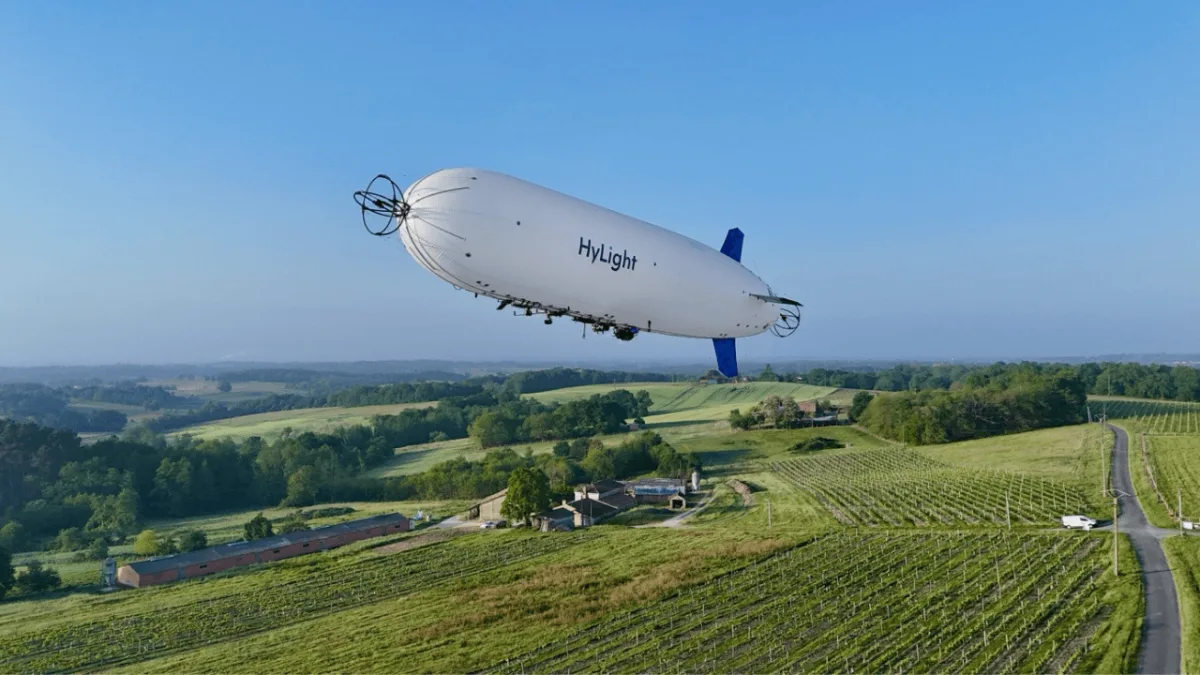
HyLight's aircraft are already deployed across European networks to monitor integrity, spot defects, and detect methane leaks, displacing helicopter operations for major infrastructure clients. Measuring 12 metres in length, the HyLighter combines aircraft endurance with inspection-grade precision. Powered entirely by hydrogen with no direct emissions and minimal noise, it operates for up to ten hours while carrying up to 10 kg of sensor payloads—LiDAR, cameras, and methane detectors—delivering 1 mm per pixel imaging resolution from 25 metres altitude and LiDAR density exceeding 1,000 points per square metre.
The HyLighter holds authorisation to fly beyond visual line of sight and over critical infrastructure in rural, suburban, and urban settings. The aircraft has operated above the Palace of Versailles and been displayed on the Champs-Élysées, at VivaTech, and the Grand Palais, proving its capability in complex, densely populated zones. Flights are managed remotely from HyLight's control centre in Paris rather than requiring on-site pilots.
Regulatory pathways and public trust
HyLight has worked closely with French and European aviation authorities to obtain flight permissions enabling large-scale operations without ground-based pilots. Bocken acknowledged the inherent complexity: "Whenever you develop something that flies, you're going to face regulatory challenges. The key has been working hand in hand with French and European regulators." While the EASA sets European aviation standards, individual nations must grant final approvals. HyLight's buoyant design—operating more like hot-air balloons than conventional drones—reduces operational risk, according to Bocken.
Regulatory clearance represents only half the battle. Public acceptance carries equal weight, particularly in nations like Germany where surveillance and privacy sensitivities run deep. Bocken contends that the aircraft's appearance and quiet operation distinguish it from conventional drones in the public mind. "When you see a hot-air balloon above your house, you're not afraid of it. You like it. It's exactly the same with HyLight's technology." He noted that residents frequently photograph and share videos of HyLight flights online, contrasting sharply with conventional drones—some of which have reportedly been shot at by people fearing foreign surveillance.
Bocken emphasised the broader principle: "Social acceptance is key when you're developing something that will dramatically change part of society."
European sovereignty and infrastructure security
Technological sovereignty in Europe increasingly encompasses critical infrastructure monitoring, especially as operators grapple with heightened security risks. For Bocken, the questions of where data originates, who controls it, and how it is preserved form the foundation of trustworthy inspection systems. "Sovereignty in surveillance markets is key. Europe has an important role to play, particularly when it comes to where data is collected, who collects it, and how it's stored."
HyLight has deliberately prioritised European suppliers and French-based development, steering clear of defence applications to concentrate on civilian critical infrastructure. Two recent helicopter incidents underscore the risks of low-altitude operations: in April, a helicopter struck a power line during agricultural spraying and crashed into a greenhouse; in October, another helicopter severing a high-voltage cable during an electricity infrastructure inspection forced an emergency landing and cut power to roughly 150 households.
Bocken responded pointedly: "You look at that and think, why are we still using helicopters for this? It's too risky. We want to change that, and we're already doing it." Beyond electricity networks, potential applications span telecom towers, gas pipelines, railways, and roads. "It's about maintenance, sovereignty, and protection. If we don't have electricity, we don't have anything else."
From data collection to predictive intelligence
HyLight is building tools that transform flight-collected data into actionable intelligence, enabling continuous network monitoring and predictive maintenance strategies. Its data-processing pipeline, already operational, automatically identifies and pinpoints vegetation-related hazards near infrastructure plus more than 50 defect categories across power grids. Rather than forcing maintenance teams to interpret thousands of images, the system delivers risk summaries with location data and visual backing.
This capability allows teams to catch problems earlier, respond with greater efficiency, eliminate unnecessary field visits, and track asset changes over time. Bocken explained the trajectory: "The more we fly, the more historical data we collect, and the more value we can provide. Ultimately, it's about moving from reactive maintenance to predictive maintenance." Such capabilities grow increasingly vital as climate change, heat waves, wildfires, and rising electricity demand strain European infrastructure.
HyLight intends to develop a platform consolidating and analysing inspection data to forecast risks and strengthen infrastructure resilience. Frequent flights will also enable the company to construct and refresh high-definition digital twins of infrastructure and surrounding landscapes. The longer-term vision encompasses a multimodal data layer spanning roads, cities, forests, and agricultural land—opening doors to applications in insurance, farming, environmental tracking, and public land stewardship.
Currently, HyLight operates an integrated service model rather than licensing its technology or data platform independently. The company handles design, manufacturing, operations, data collection, and insight delivery as a unified offering. Bocken explained the rationale: "Because we control the entire process, we can optimise everything and provide more value while remaining competitive."
Scaling production and European expansion
Building an integrated hardware-software enterprise in Europe presents obstacles, yet Bocken views the continent's engineering talent and industrial heritage as major assets. HyLight has recruited staff from across Europe and collaborates with suppliers and partners in Italy, the UK, Germany, and the Czech Republic. "I think the concentration of knowledge and deep technology expertise in Europe is huge. We're working in France, but we're a European company."
Surging customer demand prompted the capital raise. "Demand is incredibly high, and our clients have been pushing us to inspect more and more kilometres. We needed to scale, and we needed to move quickly." Helmer Schukken, managing partner at Rubio Impact Ventures, sees transformative potential: "HyLight offers a clean and scalable alternative that does the same work reliably, even over densely populated areas, and has the potential to deliver unrivalled cost savings."
HyLight has opened a new manufacturing facility and plans to bring additional strategic component production in-house while expanding its fleet from four to 15 aircraft within twelve months. The funding will also support hiring 50 new employees across engineering, AI, data, operations, regulatory affairs, and business development, plus strengthening automated data analysis capabilities. The company targets commercial expansion across Europe beginning next year, with Germany and the Netherlands as primary markets and Belgium under consideration.
Source: Tech.eu