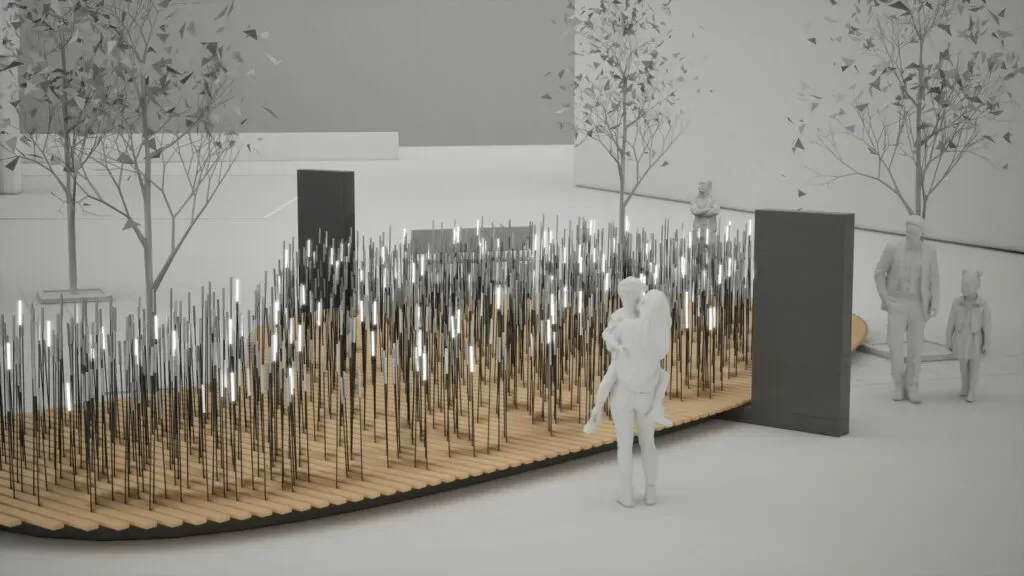
Munich's city government has formally assigned Ars Electronica Futurelab to design a participatory and hybrid memorial dedicated to those killed by the Nazi regime in the city. The project, titled Das Feld (The Field), will occupy the Square for the Victims of National Socialism and present the identities and personal histories of more than 10,000 individuals murdered during this period. Visitors engaging with interactive terminals will have their heartbeats detected and transmitted to the installation, causing it to illuminate and making remembrance tangible. A complementary digital platform will enable people worldwide to search for names and access biographical information.
Physical form and interactive design
The installation takes the form of a wooden surface featuring 1,280 flexible stalks positioned on the memorial square. The horizontal dimension of the work spans the years 1933 through 1945, while the vertical dimension reflects the annual death toll. These 1,280 stalks correspond to 4,482 days of systematic murder, beginning with Erwin Elias Kahn, Munich's first documented victim on 16 April 1933, and concluding on 23 July 1945.
Interactive terminals positioned around the field's perimeter display biographical information about victims based on the date approached. Each biography appears surrounded by a visual cloud containing the names of all 12,000 victims. When visitors place their hand on an integrated pulse sensor while reading, their heartbeat activates a corresponding stalk, causing it to glow. This luminescence persists for a period after departure, sustaining the presence of memory.
Online engagement and living memorial
Stalks that illuminate without an active visitor at a terminal indicate engagement occurring through the digital platform. The online component allows users to explore biographies and individual narratives from any location. Rather than functioning as a fixed monument, Das Feld operates as an evolving, participatory space where remembrance culture continuously develops and expands.
Development with victims' organizations
The project's framework emerged through consultation with Munich-based organizations representing victims' families. During an early workshop, these representatives articulated their vision for the memorial, noting that young people often wish to participate meaningfully after learning about this history in school but lack accessible channels for involvement. Das Feld addresses this gap by creating pathways for personal engagement with Nazi crimes and victim commemoration.
About Ars Electronica Futurelab
Operating from Linz since 1996, the Ars Electronica Futurelab functions as the organization's research and artistic development division. Its practice spans immersive installations and community-engaged projects that operate at the convergence of artistic practice, technological innovation and social engagement.
Statements
Remembrance is always also a reminder to us in the present to protect our democracy as the foundation for a peaceful, diverse and non-discriminatory society for all. The digital, participatory memorial of names invites interaction both on-site and online – and thus sets an example for the present and the future of the culture of remembrance. With the Arolsen Archives and the Ars Electronica Futurelab, we have the right partners by our side. All of this can only be achieved together and in dialogue with those affected. We are therefore delighted that the project has the support of the victims' associations.
Marek Wiechers, Head of Cultural Affairs, City of Munich
At the invitation of the City of Munich, the Ars Electronica Futurelab will design a hybrid and participatory memorial on the Square for the Victims of National Socialism. 'Das Feld' comprises both a media-art installation with which people on site can interact, and a digital representation accessible from anywhere in the world. At its heart is the remembrance of the approximately 12,000 Munich residents who were murdered by the Nazis between 1933 and 1945. An appalling, unprecedented crime against humanity that must never be forgotten. With 'Das Feld', we aim to foster a vibrant culture of remembrance, making it accessible to all and, at the same time, visible.
Horst Hörtner, Senior Director Ars Electronica Futurelab, CTO Ars Electronica
Source: Ars Electronica