When Russia invaded Ukraine in 2022, OneSoil—a Swiss agtech startup—found itself in an impossible position. The company had built its entire business around two markets that were suddenly inaccessible. Three successive rounds of layoffs, the exit of all three co-founders, and a complete business restructuring followed. Yet the company survived, and is now expanding globally with artificial intelligence at its core.
Katya Kheistver, OneSoil's CPO and COO, walked through the crisis and the unexpected recovery in a conversation about how the startup lost its core markets, rebuilt its business model, and is now positioning AI to democratise agricultural expertise.
When 70 per cent of your market is suddenly at risk
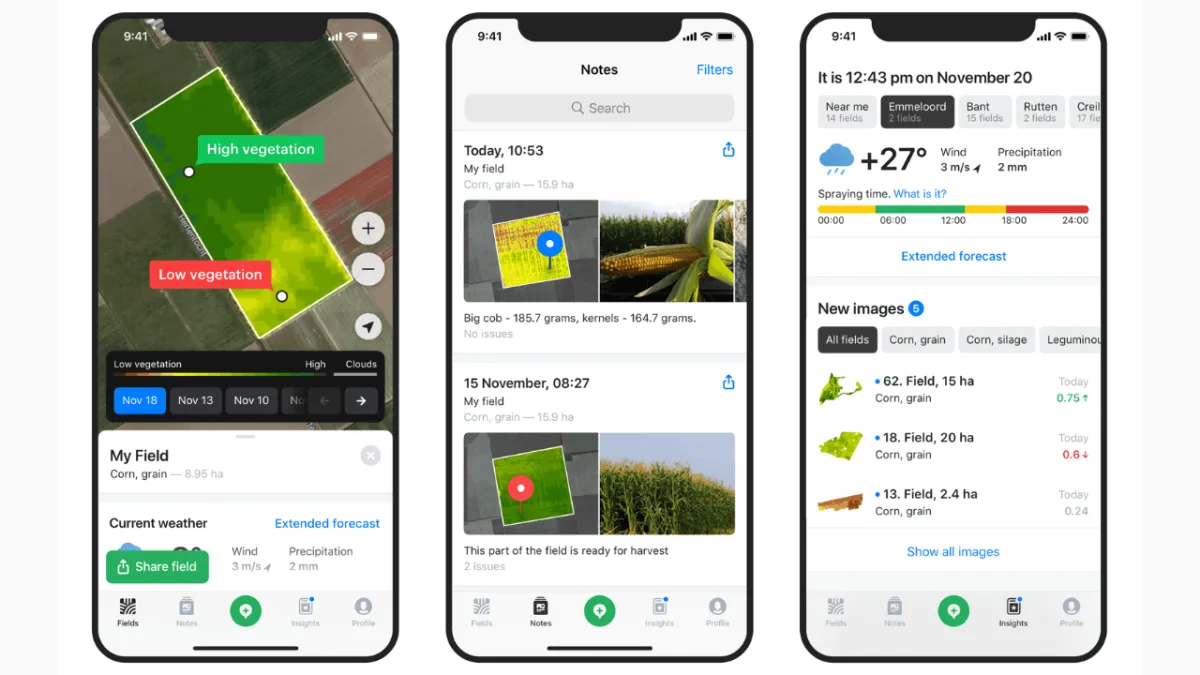
OneSoil launched in 2017, riding the wave of the Sentinel-2 satellite programme. The platform gave farmers a way to monitor their fields remotely using satellite imagery, tracking vegetation indices, spotting problems early, and coordinating observations with colleagues. For Ukrainian and Russian farms spanning thousands of hectares, this technology was transformative—a farmer managing 2,000 hectares cannot walk every field every day.
Agriculture remains vital to Ukraine's economy, though its share of GDP fell to 7.6 per cent in 2025 from 10.9 per cent before the full-scale invasion in 2022, according to World Bank figures. Ukraine produces some of the world's highest wheat yields and serves as Europe's agricultural breadbasket.
OneSoil initially offered its mobile app for free, letting farmers benefit while the company refined its crop and field-boundary recognition models. A premium tier called OneSoil Pro followed, featuring advanced precision agriculture tools such as variable-rate application of fertilisers and seeds for compatible machinery. The company had timed its commercial launch for early 2022, when roughly 70 per cent of its user base lived in Russia and Ukraine—the exact markets it expected to monetise.
We had invested considerable time and investor capital into developing it. Then the war began, and we had to reinvent ourselves almost overnight.
Katya Kheistver
OneSoil immediately chose not to pursue revenue in Russia. Supporting Ukrainian farmers continued, but few had the appetite to invest in precision agriculture amid invasion and displacement. The company relocated staff, slashed expenses, and rewrote its international playbook.
We went through three rounds of layoffs, and every one was extremely painful. Before the war, we had approximately 70 to 80 employees. Today, we have around 30, having started to rebuild the team.
Katya Kheistver
Within two years, all three founders had departed. Rather than fold, OneSoil rebuilt its leadership, restructured around international markets and precision agriculture, and began exploring artificial intelligence as a new strategic pillar.
Finding new markets — and unexpected success in Africa
The company doubled down on Europe, especially Poland, while opening operations in Brazil and Argentina and scouting South Africa. Latin America seemed the obvious choice—large farms, advanced machinery, and strong demand for variable-rate technology mirrored the Ukrainian and Russian markets OneSoil knew well.
Reality proved harsher. Brazil and Argentina are crowded agtech markets where farmers face steep taxation, weak government support, and weather risk. Agricultural input suppliers also bundle free digital tools with their products, conditioning farmers to expect no-cost technology. OneSoil found itself outmatched.
South Africa, by contrast, thrived. Africa is now OneSoil's second-largest revenue region after Europe, with South Africa leading the charge. The company also operates in Kenya and Tanzania and is moving into Nigeria. Kheistver saw a lesson: the market that looks best on a spreadsheet is not always where a product gains real momentum.
From growth at all costs to financial sustainability
In 2020 and 2021, much of the startup world believed that chasing a single metric—user count, for instance—would eventually attract a buyer willing to pay a premium. OneSoil abandoned that playbook.
We moved away from that approach towards building a business with positive unit economics. We're operating much more like a conventional business than a company focused primarily on venture capital-driven growth. That shift helped us survive.
Katya Kheistver
Since 2024, OneSoil has posted 106 per cent revenue growth versus 2021, expanded across Europe, Latin America, and Africa, and rebuilt parts of its engineering team. The company raised $1 million earlier this year from existing and new investors, including Belarusian serial entrepreneur Yuriy Melnichek.
OneSoil reached break-even in 2025. Kheistver expects negative EBITDA in 2026, a deliberate choice to fund scaling. "Our underlying economics are much healthier now. We've rebuilt the team, identified our strongest markets, and developed a more sustainable foundation for growth," she noted.
An AI agronomist in every farmer's pocket
OneSoil has rolled out what it claims is the first globally available AI agronomist feature in its app, designed to put agricultural expertise within reach of farmers everywhere with minimal friction. Farmers can download, map their fields, and begin monitoring instantly—no sales call, no email required. The AI agronomist is a paid optional feature.
The platform now serves roughly 140,000 annual users monitoring approximately 70 million hectares—a reach comparable to much larger agricultural companies despite their vastly bigger marketing budgets. OneSoil wants to be a farmer's first digital tool, not a system built only for large operations with expensive machinery.
We're not designing exclusively for highly advanced farmers with expensive machinery. We want OneSoil to be a farmer's first digital agricultural tool and then help them progress towards more sophisticated precision agriculture practices.
Katya Kheistver
The AI agronomist combines OneSoil's agricultural data with five specialised agents that guide farmers through decisions. Kheistver explained the difference from generic AI:
What makes our system different from a general-purpose AI model is the information and agricultural expertise behind it. We combine satellite imagery, weather data, field boundaries, crop recognition, and productivity-zone models.
Katya Kheistver
This gives the AI detailed context about a farmer's fields before any conversation starts. OneSoil has also built its own satellite-image processing technology, filtering snow and shadows and merging multiple images.
We've also developed our own technology for processing satellite imagery efficiently, including filtering snow and shadows and combining images.
Katya Kheistver
Unlike general-purpose AI, OneSoil's system recognises when it lacks sufficient information and asks for more before recommending action. In farming, bad advice about crop treatment, fertiliser, or pesticide use carries real financial and operational risk. The AI is built to request follow-up questions or additional evidence rather than rush to a conclusion.
"For example, if a farmer suspects a crop disease, the AI might ask them to visit the field and upload a photograph before recommending a pesticide. It needs sufficient evidence before making that recommendation. That's one of the fundamental differences between our AI agronomist and simply asking a general-purpose model such as ChatGPT, Claude, or Gemini. We provide proprietary agricultural data and structure the agents to behave more like agronomists who know when additional investigation is necessary," Kheistver explained.
OneSoil has accumulated eight years of historical agricultural data, which it used to train and test the AI agronomist against known conditions and outcomes. The company then worked with farmers, agronomists, and partners across multiple countries to validate the system in real-world settings before commercial release.
Building trust alongside technology
Even as AI capabilities expand, moving farmers toward advanced precision agriculture remains difficult. Farmers often need human support before investing in new machinery or changing practices. Technology alone cannot replace expertise.
OneSoil competes in a crowded precision agtech space alongside large agricultural input companies and regional providers. The company is not trying to become a comprehensive farm management platform. Instead, it focuses on field monitoring and actionable insights.
We want to help farmers understand what's happening in their fields, identify problems, and make better agricultural decisions. Other platforms may offer some overlapping features, but their primary focus is often managing farm operations.
Katya Kheistver
OneSoil sees its independence as a competitive edge. In some regions, farmers distrust agricultural input suppliers offering digital services bundled with fertiliser sales. Data handling also matters. Though agricultural companies have approached OneSoil to buy its data, the company has never sold farmers' personal information and says it will not.
You might make money from selling that information once, but what happens to the relationship with your users afterwards? Trust is extremely important in agriculture. Our terms and conditions make clear that we don't share farmers' personal data.
Katya Kheistver
We want farmers to trust that our recommendations are designed to help them make better decisions.
Katya Kheistver
Why Africa could drive OneSoil's next phase of growth
OneSoil sees substantial growth potential in Africa, where rising agricultural investment, shifting farming methods, and a younger, digitally literate generation of farmers are opening doors for agtech adoption.
Kenya, Tanzania, and Nigeria are witnessing growing appetite for advanced farming techniques. Farmers increasingly have the chance to adopt digital solutions without passing through every stage of traditional agricultural digitalisation. "Many farmers are relatively young and comfortable using mobile technology, so they can move directly to more advanced solutions," Kheistver said.
Access to agronomic expertise is another bottleneck. In many regions, qualified agronomists are scarce or expensive, creating an opening for AI-powered guidance. For a company forced to rebuild after losing its original markets, the opportunity is to bring years of satellite data and agricultural knowledge to farmers who previously had little access to either.
Farmers don't necessarily need to find and pay for an agronomist. They can download the app and get agricultural guidance much faster, in real time.
Katya Kheistver
Source: Tech.eu