Releaf, a Ukrainian-founded company based in Paris, is converting fallen urban leaves into fibres destined for packaging, paper and other materials—offering an alternative to wood-based paper production. By working with established paper producers, the company enables them to adopt its materials within their current industrial processes, rather than forcing them to construct new manufacturing facilities from scratch.
From scientific breakthrough to commercial reality
While many startups have shown that alternative materials function scientifically, moving from laboratory to market remains a significant hurdle. Founder and CEO Valentyn Frechka emphasises that two elements determine success: how a company positions itself and its proximity to both material sources and end customers.
If you position yourself as a breakthrough company that's going to compete directly with major corporations, you're already putting yourself in a difficult position. These are enormous businesses with established infrastructure and supply chains. Trying to disrupt that model by introducing something completely new often doesn't work.
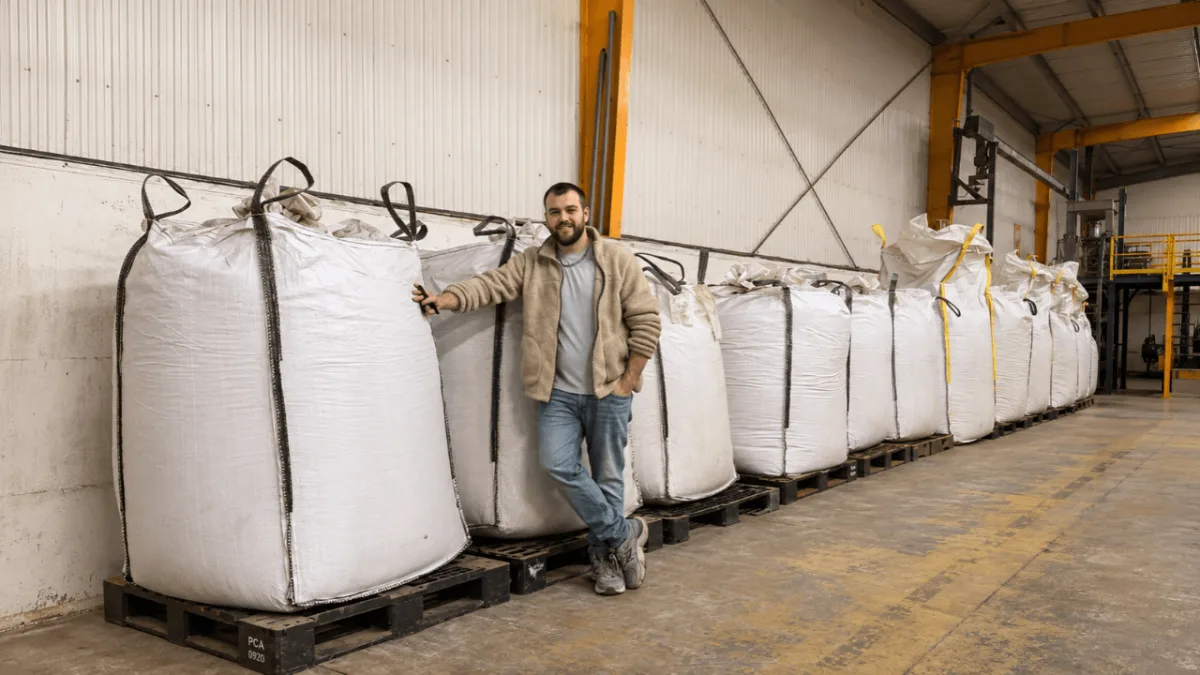
Valentyn Frechka, founder and CEO of Releaf
Frechka stresses that logistics, geography and supply chain resilience matter just as much. European customers, he notes, may hesitate to purchase goods made elsewhere when geopolitical tensions could threaten their sourcing.
If you're targeting European customers, for example, they may be reluctant to buy products manufactured elsewhere, particularly when geopolitical instability could disrupt their supply chains.
Valentyn Frechka
Releaf initially believed its best path was selling fibres directly to customers. The team soon realised, however, that downstream buyers cared more about the finished product than the source of its raw materials. This insight prompted a strategic pivot: Releaf shifted toward producing paper for converters—companies that turn raw materials into finished packaging.
Turning fallen leaves into an industrial raw material
The shift from plastic to paper reduces reliance on fossil fuels but introduces a fresh problem: rising demand for virgin wood fibres. Frechka highlights the inefficiency: trees require five to ten years or more to mature, yet the paper they become might be used as a shopping bag for just two hours.
If we can produce a material with the same properties, at a comparable price, using an alternative raw material that's less vulnerable to supply chain disruption, why wouldn't the industry consider it? That's the problem Releaf is addressing.
Valentyn Frechka
Releaf operates primarily as an engineering and materials company, developing technologies to transform fallen urban leaves into components for paper, packaging and other uses. The company employs two distinct technological approaches.
The first is a dry mechanical process that yields a material suitable for incorporation into existing paper machinery as a filler. The second combines chemical and thermal treatment with refining to extract short fibres that behave like cellulose fibres from trees. Together, these methods provide Releaf with flexibility to produce materials that match conventional paper performance.
Releaf collaborates with municipalities and industrial partners across France, Germany, the Netherlands and Italy. Its roster includes several French cities, commitments from German municipalities and partnerships with three of France's largest paper groups. Global brands including Uber Eats, Chanel, L'Oréal, Samsung and Rituals have tested its materials.
The economics of turning municipal waste into paper
Cities already collect fallen leaves as part of their regular upkeep. According to Frechka, "They did it before Releaf existed, and they'll continue doing it." Municipalities manage this seasonal debris for practical and health reasons: leaves rotting on streets create slippery hazards, and collected leaves typically end up composted or burned.
Both disposal methods have drawbacks. Leaf compost carries minimal economic value, and composting operations often depend on public funding. Incineration poses its own problems: leaves contain sand and minerals that can erode boiler equipment over time.
Releaf sees potential in converting this existing waste stream into a usable industrial input. In Germany, the company is partnering with an organisation in Dortmund to test the model. In Paris alone, Frechka estimates that tens of thousands of tonnes of leaves could become available, depending on collection scope. Partnering with Releaf could cut municipal leaf disposal expenses by at least half, redirecting those savings toward other city services.
The seasonal timing of leaf collection, however, creates logistical complications. Managing and preserving large quantities of biomass forms a core part of Releaf's intellectual property.
We receive large volumes of material within a relatively short period, so we need to process and preserve them efficiently.
Valentyn Frechka
Releaf's preparation line removes impurities and contaminants, then compacts leaves into bales and treats them to prevent deterioration. This process allows the company to store roughly 400 kilograms of leaves per cubic metre. The prepared material can then feed into either dry or wet processing systems, depending on its final use.
Last year, Releaf processed approximately 1,000 tonnes on its pilot line and is preparing to handle roughly double that volume in the coming season.
Why Releaf isn't building its own paper mills
Releaf retains its core technology internally—particularly the processes for transforming leaves into fibres—while partnering with established industrial manufacturers to produce finished materials. This approach sidesteps the enormous capital investment needed to build and operate paper mills.
The paper industry is extraordinarily complex. Building and operating a paper mill requires enormous investment and technical expertise. Working with existing manufacturers allows us to avoid those costs.
Valentyn Frechka
Frechka sees these partnerships as providing valuable technical and commercial validation as well.
If an established paper mill is willing to introduce our material into its production processes, that demonstrates the technology can work within existing infrastructure. These companies wouldn't take the risk of introducing an unfamiliar material unless they saw a genuine commercial opportunity.
Valentyn Frechka
Yet established industries move slowly when adopting new technologies, especially when manufacturing changes carry substantial financial risk. Frechka contends that penetrating the paper sector demands both technical knowledge and a solid financial argument.
You need to understand the industry from the inside. Technical knowledge is essential because this is an extremely competitive and complex sector where mistakes can be very expensive.
Valentyn Frechka
Frechka's background in biotechnology and genetic engineering has equipped him with years of research into fallen leaf properties, including the molecular composition of their fibres. This expertise gives him insight into how Releaf's materials perform under different manufacturing speeds, conditions and volumes.
When you approach an industrial manufacturer, you need to speak their language. You can't simply arrive with an interesting sustainability story. You need to demonstrate that your material works technically and makes economic sense.
Valentyn Frechka
For a manufacturer producing 500,000 tonnes of paper annually, Frechka suggests that a steady supply of 100,000 tonnes of alternative raw material could prove attractive if it lowers costs without sacrificing product quality.
From cardboard boxes to luxury packaging
Though Releaf's technology can support multiple material applications, the company is deliberately focusing on paper as its initial commercial target. Frechka views it as the most recognisable and commercially mature outlet, offering a way to establish financial stability before branching into other materials.
Releaf has created several paper grades suited for cardboard boxes, paper bags, printing, graphic uses and luxury packaging. Its immediate commercial focus, however, centres on paper for corrugated packaging and bags.
Luxury packaging opens another avenue, though the sector is tightly concentrated among a small number of specialist producers, particularly in Italy. One complication lies in the geography of current supply chains: European-made paper often travels to China, India or Indonesia for conversion into packaging, then returns to Europe as a finished product.
Frechka sees a chance to compress these supply chains by moving more production nearer to European luxury brands.
Our hypothesis is that we could produce the raw material, paper and finished packaging locally for European luxury brands. We're currently validating that approach with several customers, including discussions with Kering and LVMH, as well as independent luxury brands. Of course, we're not suggesting that every luxury brand will replace all its existing packaging. But there are clear opportunities in e-commerce packaging and secondary packaging.
Valentyn Frechka
In September 2026, Releaf announced a partnership with Italian paper and cartonboard manufacturer RDM Group and its Dutch subsidiary Eska to create leaf-based materials for premium and luxury packaging. The collaboration's debut product merges Eska's 100 per cent recycled solid board with a Releaf leaf-based paper laminate, preserving the natural look of fallen leaves while fulfilling technical demands for applications such as luxury boxes and book covers.
Unveiled at LUXE PACK Monaco, this material exemplifies Releaf's strategy to penetrate higher-value packaging markets by working through existing industrial production systems.
Building a materials company beyond paper
Releaf's vision for the future is to establish itself as an international materials company, functioning similarly to traditional wood-processing enterprises. While cellulose fibres for paper remain its near-term priority, the company is investigating other uses for components derived from fallen leaves, such as water-resistant packaging coatings, moulded products and bioplastics.
Growth will also allow us to reinvest in research and development and expand into other applications, including moulded packaging, biocomposites and polymers. The opportunity is much broader than paper alone.
Valentyn Frechka
For Frechka, the most significant development is that Releaf has transcended its initial scientific premise. The company has validated its technology, created commercial products and forged ties with major industrial players. He also hints at upcoming announcements involving firms he has long sought to collaborate with, some of which have now become both partners and customers.
For me, that's particularly exciting because it demonstrates that what began as a scientific idea is becoming a real industrial business.
Valentyn Frechka
Source: Tech.eu