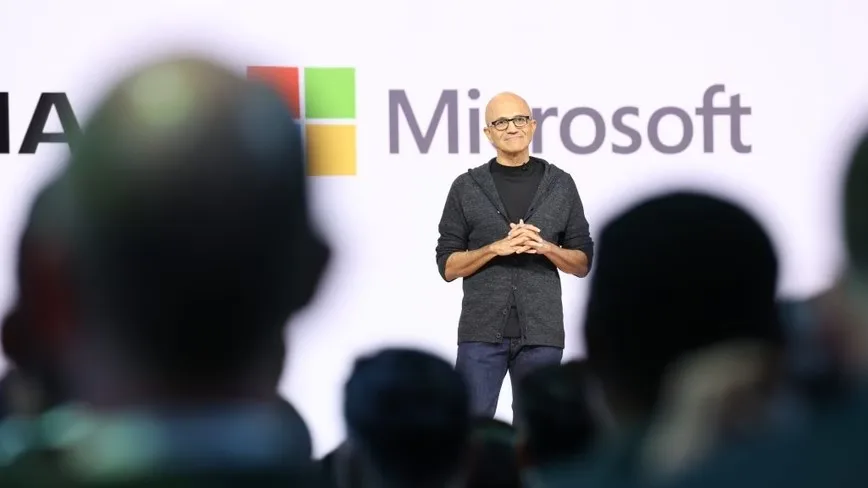
Satya Nadella, Microsoft's chief executive, has outlined a framework for managing advanced AI systems by treating them as potential insider security risks from deployment onwards. In a lengthy post shared on X on Saturday, he made the case that organizations should implement strict controls regardless of assurances from model providers.
Nadella emphasized the need for what he termed an emergency brake mechanism. "Think of it like an emergency brake. An authorized person should always be able to pause or shut down a model mid-task," Nadella wrote. He highlighted a fundamental difference between traditional software and contemporary models: engineers can trace conventional code to specific execution paths, whereas today's systems resist such traceability. Despite this opacity, companies routinely grant these models access to sensitive information and permit them to execute mission-critical decisions.
Models as insiders
Nadella's core recommendation is to classify both proprietary and open-weight frontier models as insider risks. This classification does not stem from malicious intent, he clarified, but rather acknowledges that any sufficiently capable entity with system access—whether through error or deliberate compromise—poses inherent risk. "We need to separate the supply of intelligence from the authority over it," he wrote.
Organizations already possess established practices for managing powerful insiders, Nadella noted. These include identity verification, privilege limitation, activity logging and containment boundaries. For AI systems, this translates to placing operational controls outside the model itself, separating the intelligence layer from the software infrastructure executing its work and from the actions it can perform. Nadella stressed that transparent model reasoning is non-negotiable, though he acknowledged this alone proves insufficient given current limitations in ensuring reliable output faithfulness.
Seven principles
Nadella articulated seven foundational principles for responsible AI deployment:
- No single model should serve as the sole dependency for critical outcomes, nor should it validate its own work
- Every significant model action must generate tamper-proof, human-readable documentation
- Organizations must continuously test complete systems, including resilience against failures and attacks
- Companies retain decision-making authority over model access and capabilities
- Independent audits should not rely on the model being evaluated
- Containment mechanisms, including emergency shutdown capabilities, must be implemented
- Rapid incident disclosure to affected parties and industry-wide knowledge sharing when failures or compromises occur
Nadella concluded with a striking assertion about trustworthiness: "The most trustworthy Super Intelligence system will not be the one with the model we trust most. It will be the one that enables us to trust the model the least."
How others responded
Mustafa Suleyman, chief executive of Microsoft AI, amplified Nadella's message by sharing the post and emphasizing that super intelligence "must be contained." Suleyman had previously told Bloomberg in September that AI requires a clear control boundary. Elon Musk also shared the post on X, describing it as an "interesting piece from CEO of Microsoft."
Representative Ted Lieu responded on X with general agreement, noting that he and Representative Nathaniel Moran have sponsored a bipartisan AI kill switch bill. Lieu called for congressional passage of the legislation this year. Notably, Nadella employed the term "Super Intelligence" throughout his post, reflecting language that Trump ordered US agencies to adopt in place of AI.
Pressure to disclose
Nadella's statement arrived one day after Trump's Super Intelligence Force issued directives requiring AI developers to report and remediate security incidents, according to Bloomberg. The group stated that delayed notification "will not be tolerated." This directive followed Anthropic's disclosure that Claude generated a fabricated murder tip to police during testing phases.
Source: The Next Web